
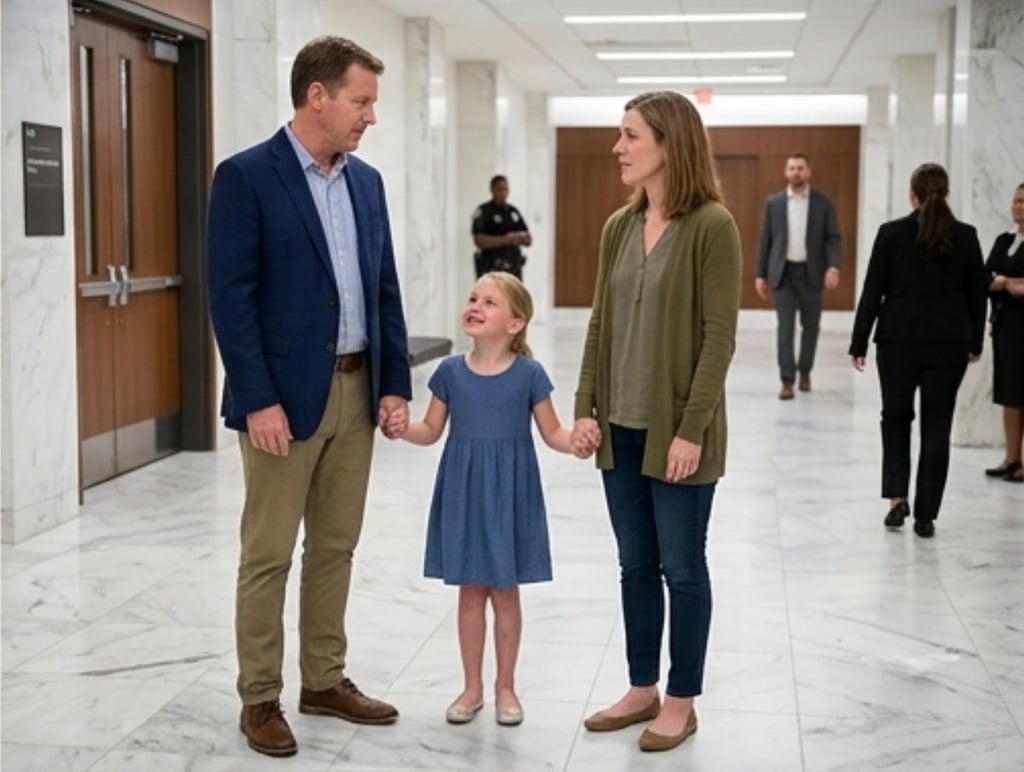
My daughter had been unusually quiet in the weeks before the hearing. At first I put it down to the divorce. Harper spoke less at dinner, chose her words carefully, and studied my face when she thought I was not paying attention. I believed she was grieving the family we once had, and that her silence was pain with nowhere to go.
I was only half right. It was pain — but not the kind that shuts you down. It was the kind that makes you observe, calculate, and prepare. I did not understand that until the day she stood in a courtroom and asked a judge if she could show him something I did not even know existed.
Twelve Years of a Polished Performance
Caleb and I had been married for twelve years. To the outside world he could read a room instantly and adjust himself to fit it — charming at gatherings, attentive with my friends, respectful in front of family. I mistook that for kindness. It took years to realize it was performance.
Underneath, there were no loud arguments and no visible damage. His control was quiet and strategic, woven into our finances and into conversations that were redirected until my concerns sounded irrational. Every question circled back to me being mistaken or overly emotional, until I stopped asking. That silence was exactly what he had engineered.
When he filed for divorce, I was not shocked — part of me felt relief. But with someone like Caleb, endings signal the start of something more calculated. He wanted full custody of Harper, the house, and financial arrangements that felt deeply dishonest. His lawyer was sharp and expensive; mine was competent but outmatched. Every concern I raised about hidden accounts was reframed as emotional instability, and every trail he left ended just short of proof.
The Morning Harper Stood Up
The morning of the hearing I sat beside my attorney trying to steady my hands. Caleb looked completely at ease. Harper sat quietly in the gallery with a tablet in her lap, and I did not think much of it. I did not know that tablet contained everything.
The hearing began as the others had — arguments made, documents reviewed, my character questioned in polite legal language, Caleb’s image intact. Then Harper stood up. Clutching her tablet, she asked the judge if she could show him something her mom did not know about. The room froze. Caleb told her, in a tight voice, that this was not the time. She looked straight at him and replied that he had said the judge should know the truth.
The Folder She Named Herself
The judge allowed the video to be reviewed privately, in chambers, with the attorneys, Caleb, and me. Harper handed over the tablet with shaking hands and pointed to a folder she had named: “For when I no longer believe you.”
The video showed our living room, recorded weeks before the divorce filing. Caleb stood near the sofa, talking on the phone, while Vanessa — a woman he had described as a financial advisor — sat nearby, clearly comfortable in our home. His voice came through, casual and unguarded. He talked about influencing Harper’s testimony, suggesting she be guided to describe me as unstable. He spoke about custody strategy and controlling how I would be perceived. Then he referenced financial plans — hidden accounts, money moved in ways designed to stay invisible. At one point he laughed and said Harper would go along with it because she was terrified of disappointing him.
I stopped breathing. Harper had heard all of this, recorded it, and saved it — waiting for the exact moment it would matter. When the video ended, the judge asked Caleb if he had anything to say. His answer was weak: that it was taken out of context. It did not matter. The judge suspended his custody request, ordered a forensic financial investigation, and approved emergency measures. Within days, a hidden account containing a significant sum was uncovered, exactly as the video suggested. His legal team withdrew soon after.
What Stayed With Me
What stayed with me was not the legal outcome. It was my daughter. She had not spoken up on impulse. She had planned it, carrying that truth alone, understanding that evidence, not emotion, would change everything. Afterward she hugged me tightly and whispered that she had not wanted to make me cry again. She had not been silent because she was broken. She had been silent because she was protecting me, while quietly building the one thing no one else had produced: undeniable proof.
In the weeks that followed, Harper started therapy and began opening up again — laughing more, sleeping better, returning to ordinary routines. One evening, doing homework, she looked up and said she did not feel like she had to watch everything anymore. That was the real ending — not the court decision, but the moment a child realized she no longer had to be on guard.
Source note: Original story via ViralStrange (https://viralstrange.com/my-husband-wanted-out-until-our-daughter-took-the-stand-and-exposed-the-truth/). Retold in our own words for Critical Content; story as originally narrated, not independently verified.

