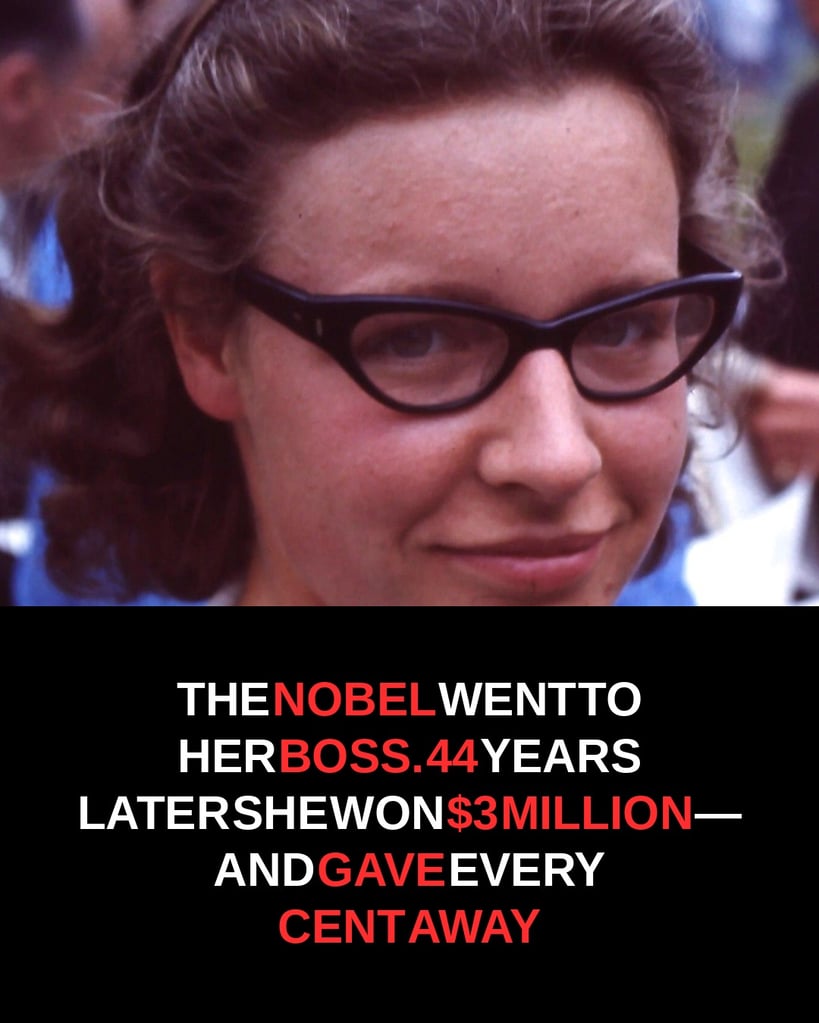
She found it first. Her boss got the Nobel. And when her own prize finally came, 44 years later — $3 million, hers to keep — Jocelyn Bell Burnell gave away every cent of it, to students the system overlooks. Some stories take half a century to finish. This one finished perfectly.
In 1967, Bell Burnell was a PhD student at Cambridge, working through telescope chart data by hand. She was the first person to notice the strange repeating radio signal in that data — a signal nobody could explain, ticking with impossible regularity. It was the first pulsar ever detected: a discovery that changed astronomy.
The discovery won the 1974 Nobel Prize in Physics. The prize went to her supervisor, Antony Hewish, shared with Martin Ryle. The student who first spotted the signal was left off it.
Left off the prize, never out of the story
History has a long record of that shape — the junior person, often a woman, whose eyes found the thing, and whose name the honor skipped. What distinguishes Bell Burnell’s story is not the snub; it’s what she did across the 44 years that followed. She kept working, kept her standing in her field, and let the record speak. The science community never forgot whose eyes found the pulsar first.
Then, in 2018, the correction arrived in the form of a check. Bell Burnell received the Special Breakthrough Prize in Fundamental Physics — $3 million, one of the largest prizes in science, awarded to her, by name, for the discovery she made as a student.
Every cent, given away
And here is the part that makes this story belong on a page about paying it forward. She donated the entire amount — the whole $3 million — to the Institute of Physics, to fund graduate scholarships for students from under-represented groups: the Bell Burnell Graduate Scholarship Fund, supporting women, ethnic minorities, and refugees entering physics.

Think about the logic of that gift. The system once decided a young woman’s discovery belonged on her supervisor’s shelf. Her answer, given the chance, was not revenge and it wasn’t retirement money. It was a fund whose entire purpose is to make sure the next under-represented student — the next pair of eyes the room might overlook — gets to stay in the room.
She couldn’t retroactively put her name on 1974. She could absolutely decide whose names come next. She did.
Join the conversation
Have you ever done the work and watched somebody else take the credit? And tell us honestly: if a $3 million correction arrived in YOUR life after 44 years, could you give away every cent of it? Tell us below.
Source note: Jocelyn Bell Burnell’s account — as a Cambridge PhD student in 1967, the first person to notice the strange repeating radio signal in telescope chart data, the first pulsar; the 1974 Nobel Prize in Physics going to her supervisor Antony Hewish (shared with Martin Ryle), with Bell Burnell left off it; her 2018 receipt of the $3 million Special Breakthrough Prize in Fundamental Physics; and her donation of the entire amount to the Institute of Physics to fund the Bell Burnell Graduate Scholarship Fund for students from under-represented groups — women, ethnic minorities, and refugees — is from NPR (September 6, 2018), the Associated Press (September 2018), and Times Higher Education.
Tell us in the comments below - we read every single one, and the best takes get featured.