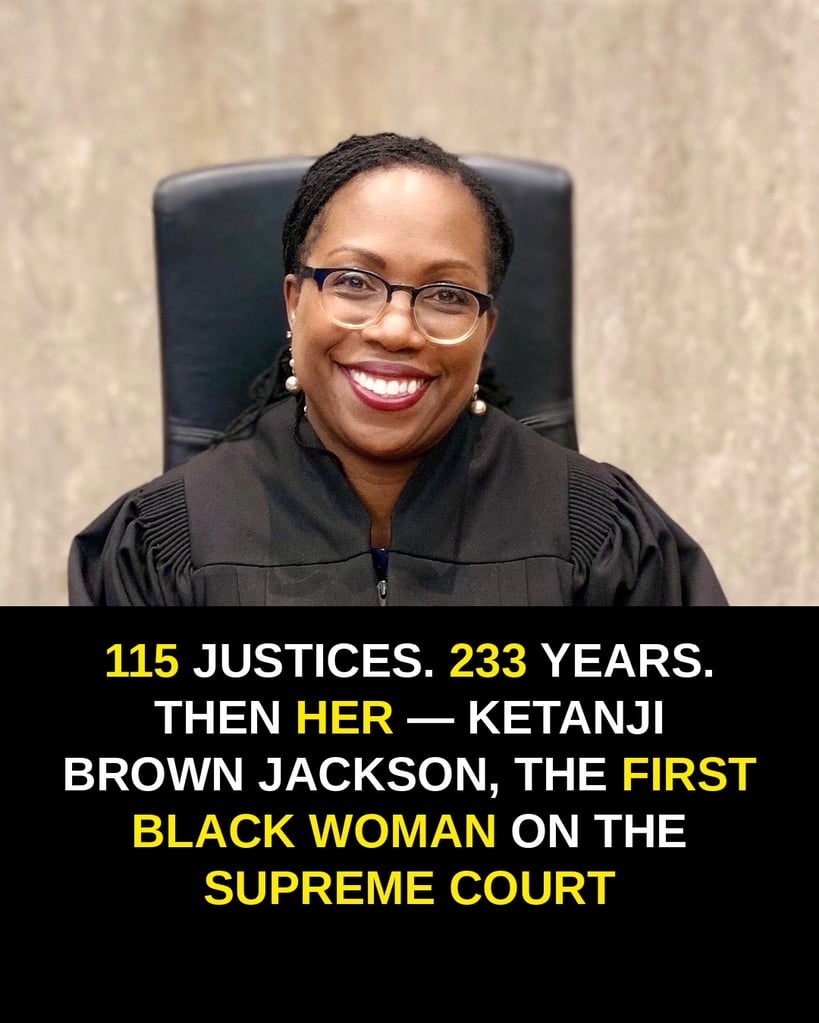
Count the portraits. For 233 years, the highest court in the United States seated justice after justice — 115 of them — and not one was a Black woman. Then the count reached 116, and the portrait wall changed forever.
Ketanji Brown Jackson was confirmed by the Senate on April 7, 2022, by a vote of 53–47, and sworn in on June 30, 2022, as the 116th justice of the U.S. Supreme Court — its first Black woman, and its first former public defender. Two firsts in one oath, arriving 233 years after the Court began.
Two firsts in one justice
Either first, alone, would have made history. Together, they tell you something about the road she traveled.
The first Black woman part is the one the headline count makes plain: 115 justices before her, zero Black women among them. Generations of Black women lawyers, judges and scholars were qualified in every era of that 233-year span — the absence was never about a pipeline. It was about a door. On June 30, 2022, the door opened.
The second first is quieter and just as remarkable: she is the Court’s first former public defender — a justice who had done the work of representing people who could not afford to pay for their own defense. The Supreme Court is where the country’s hardest legal questions end up. For the first time, one of the nine people answering them had stood in courtrooms on behalf of the accused poor. That experience had simply never been in the room before — in 233 years.
She succeeded the man she once clerked for
The story has a full-circle detail no novelist would dare invent. Jackson succeeded Justice Stephen Breyer — the very justice she had once clerked for. A clerkship is the closest apprenticeship in American law: a young lawyer working at a justice’s elbow, learning how the Court thinks from inside the chambers. She learned the job in Breyer’s chambers. Then, on his retirement, she took his seat.

Read that again the way a young woman watching at home would. The clerk became the colleague-class successor. The assistant’s chair, held with excellence, became the justice’s chair. It is the strongest possible answer to anyone who has ever been told to be grateful just to be in the room: she was in the room, she did the work, and the room eventually became hers too.
Why the number 116 matters on this page
Natural Hair Rules celebrates firsts — and insists on counting them honestly. 116 is not a small number. It means 115 chances, across 233 years, passed before a Black woman was seated on the nation’s highest court. That’s why the oath on June 30, 2022 mattered far beyond one career: little girls watching the ceremony could, for the first time in American history, see a Black woman take that seat and know the portrait wall now includes somebody who looks like them.
Firsts like this don’t end a story. Like Halle Berry’s open door and Ruby Bridges’ empty classroom, they start the count on the next one. The second Black woman justice, whenever she comes, will walk a road that begins with 116.
Join the conversation
Where were YOU when the 116th justice took the oath — and what did it mean to you to finally see a Black woman on that bench after 233 years? And be honest: which “first” of hers hits you harder, the race barrier or the public defender one? Tell us below.
Source note: Ketanji Brown Jackson’s Senate confirmation on April 7, 2022 (53–47), her swearing-in on June 30, 2022 as the 116th justice of the U.S. Supreme Court — its first Black woman and its first former public defender — and her succession of Justice Stephen Breyer, for whom she had clerked, are per AP and ABA Journal swearing-in coverage (June 30, 2022) and Britannica.
Tell us in the comments below - we read every single one, and the best takes get featured.