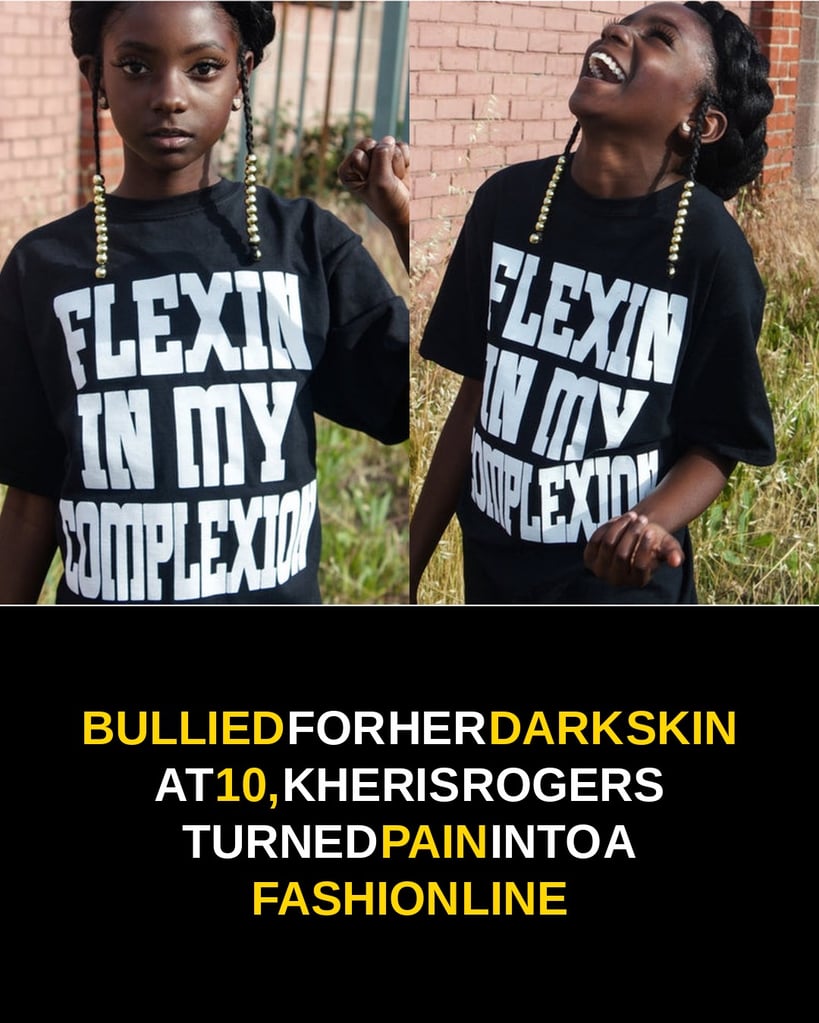
The bullying followed her through two schools. Kheris Rogers was teased for her dark skin — and, in her own telling, for her kinky hair — first at a predominantly white school, and then, in the particular sting of colorism, again after she switched schools. The words that carried her out of it came from her grandmother: “flex in your complexion.” At 10 years old, she put them on a shirt.
That sentence deserves to sit still for a moment. A grandmother looked at a little girl being taught to shrink and handed her the opposite instruction: don’t hide the skin they’re mocking — flex in it. Show it off. Kheris’s big sister, Taylor Pollard, understood the power of the moment: on March 26, 2017, she tweeted photos of Kheris with the hashtag #FlexinInHerComplexion. The internet did the rest. The photos went viral, and thousands of people who had lived some version of that bullying saw a child answering it in four words.
In April 2017, at 10 years old, Kheris launched the clothing line: Flexin’ In My Complexion. Her grandmother’s kitchen-table wisdom became a brand, and the motto that was armor for one little girl became armor anybody could buy and wear.
The youngest designer New York Fashion Week had seen
That September — September 10, 2017, at the Museum of the City of New York — Kheris presented at New York Fashion Week as the youngest designer ever to showcase there. (Sources split on whether she was 10 or 11 at the show itself, so this page pins her age to the launch — 10 — and calls the show what every source agrees it was: NYFW’s youngest-ever showcasing designer.)
What came after reads like a career, because it was one. A Nike campaign, through LeBron James’s collection. Teen Vogue’s 21 Under 21, in 2018. And her children’s book, Shine Bright — the girl who was bullied for the skin she was in, writing the book she needed for the next girl standing where she stood.

Hold the whole arc at once, because it is the entire point: the mockery named the thing — her complexion, her hair — and her grandmother renamed it as the crown. Kheris didn’t wait to grow up and get over it. At 10, she monetized the comeback, walked it down a New York runway, and printed it on children’s backs across the country.
The later chapters matter because they prove the motto scaled beyond a viral moment. A Nike campaign through LeBron James’s collection put Flexin’ In My Complexion in front of the biggest audience in sports fashion. Teen Vogue’s 21 Under 21 in 2018 listed her among the young women changing the culture. And her children’s book, Shine Bright, carried the message to readers too young for social media — the exact age she was when the bullying found her. The arc is the argument: a grandmother’s sentence, a sister’s tweet on March 26, 2017, a clothing line launched that April, a runway that September. Words became wardrobe became literature. That’s what a motto does when a child refuses to keep it private.
Join the conversation
Whose words carried YOU through being teased — and be honest, do we say “flex in your complexion” to the dark-skinned girls in our own families before the world gets to them? What would you tell a 10-year-old Kheris today? Tell us below.
Source note: Kheris Rogers’s account — bullied for her dark skin, and in her own telling for her kinky hair, at a predominantly white school and facing colorism again after switching schools; her grandmother’s encouragement, “flex in your complexion,” becoming her motto; her sister Taylor Pollard’s March 26, 2017 tweet of her photos with #FlexinInHerComplexion going viral; her launch of the Flexin’ In My Complexion clothing line in April 2017 at age 10; her September 10, 2017 presentation at New York Fashion Week at the Museum of the City of New York as the youngest designer ever to showcase there (sources split on whether she was 10 or 11 at the show, so only the launch age is pinned); the later Nike campaign via LeBron James’s collection, Teen Vogue’s 21 Under 21 (2018), and her children’s book Shine Bright — is from AfroTech, Because of Them We Can, and Essence-adjacent coverage. An early “$110K / 10,000 shirts” sales figure circulating on low-authority sites is not printed, as it could not be verified in strong sources.
Tell us in the comments below - we read every single one, and the best takes get featured.