
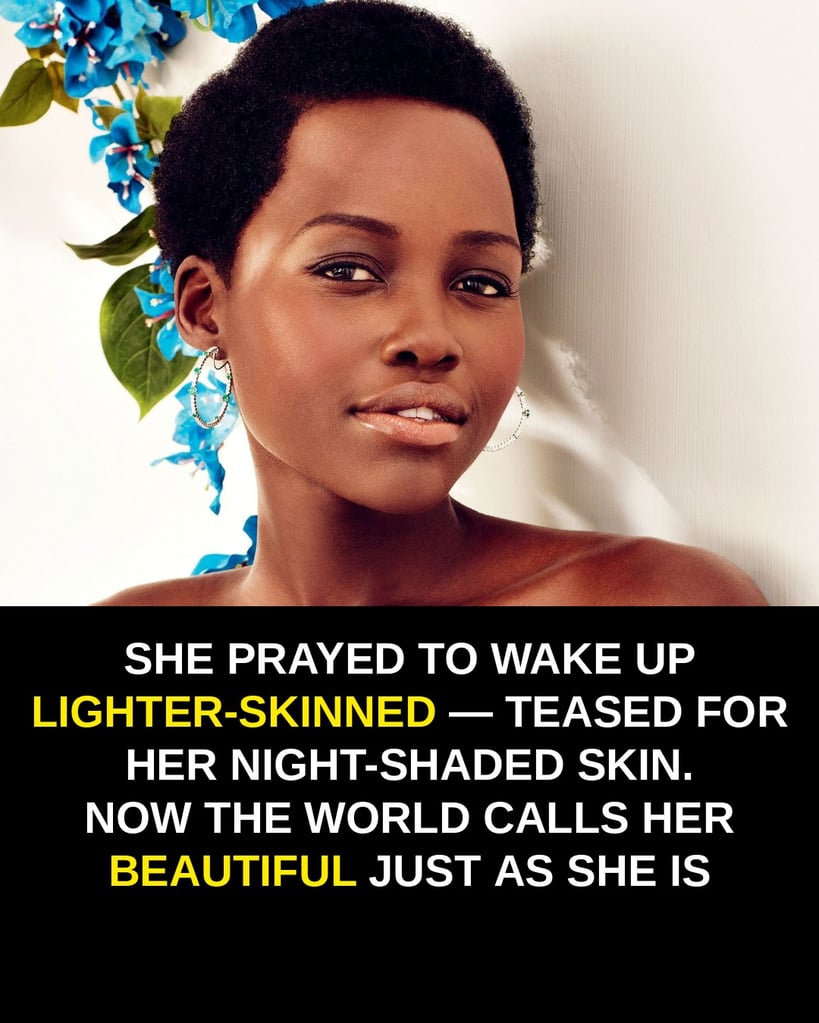
She stood at a podium in front of Hollywood’s most powerful Black women and admitted the prayer she used to pray as a young girl: that she would wake up lighter-skinned.
In February 2014, Lupita Nyong’o was accepting the Best Breakthrough Performance award at Essence‘s Black Women in Hollywood luncheon. Instead of a standard thank-you speech, she read the room a letter — from a girl who had written to tell her she was about to buy skin-lightening cream, until Lupita appeared on screen and changed her mind.
Then Lupita told the truth about why that letter hit her so hard. She had been that girl.
“I got teased and taunted about my night-shaded skin”
“I remember a time when I too felt unbeautiful,” she said. “I put on the TV and only saw pale skin. I got teased and taunted about my night-shaded skin. And my one prayer to God, the miracle worker, was that I would wake up lighter-skinned.”
She described waking up every morning hoping the miracle had happened — and the disappointment of a mirror that kept answering no. The message she had absorbed growing up was simple and cruel: the skin she was in was the problem, and beauty lived somewhere lighter.
It is a confession a lot of women on this page will recognize, even if their version wasn’t about skin. Sometimes it was hair that needed to be “fixed” before it could be beautiful. Sometimes it was features, or a body. The prayer changes shape. The feeling underneath it is the same: if I could just wake up different, I could finally be enough.
The reflection that changed it
What interrupted that prayer, Lupita said, was a face on a magazine cover: Alek Wek, the Sudanese supermodel whose dark skin and closely cropped hair were being celebrated at the very top of fashion. Seeing a woman who looked like her being called beautiful — by the same industry that had only ever shown her pale skin — cracked the story she’d been told about herself.
She didn’t claim the insecurity vanished overnight — but here was proof, in print, that her reflection was not the obstacle she had been taught it was.
Years later, the girl in the letter got the same proof from Lupita herself. That is the chain this speech is really about — Alek Wek’s cover steadies Lupita, Lupita’s screen debut steadies a stranger, and the stranger’s letter steadies a room full of women in Hollywood.
“There is no shame in Black beauty”
She closed with the line that made the speech immortal, addressed to the girl who wrote to her — and to every girl still praying that prayer:
“And so I hope that my presence on your screens and in the magazines may lead you, young girl, on a similar journey. That you will feel the validation of your external beauty but also get to the deeper business of being beautiful inside. There is no shame in Black beauty.”
Within months, Lupita would win the Academy Award for 12 Years a Slave and be named People magazine’s Most Beautiful — an honor NPR noted was significant precisely because of speeches like this one. The world didn’t just call her beautiful. It called her beautiful in the skin she once prayed to escape.
Why this one lands on a natural hair page
We know this story here. Ours is usually told over a sink or a salon chair — the years spent straightening, lightening, covering, shrinking whatever we were told was too much. The details differ. The prayer doesn’t.
Lupita’s answer was never a new face. It was a new mirror — one true reflection at a time.
Join the conversation
Be honest: what was YOUR version of that prayer growing up — and who was the first person who looked like you and made you stop praying it? Tell us below.
Source note: Lupita Nyong’o’s remarks are from her acceptance speech at Essence‘s Black Women in Hollywood luncheon in February 2014, as quoted in ThinkProgress (Feb 28, 2014) and Fashionista (2014), including the letter from the young girl, the “night-shaded skin” passage, her crediting of Alek Wek, and the closing line “There is no shame in black beauty.” Context on her People cover is from NPR, “Why Lupita Nyong’o’s ‘People’ Cover Is So Significant” (Apr 23, 2014). Her speech does not pin the prayers to a specific age, so this article describes them as she did — as a young girl growing up.

