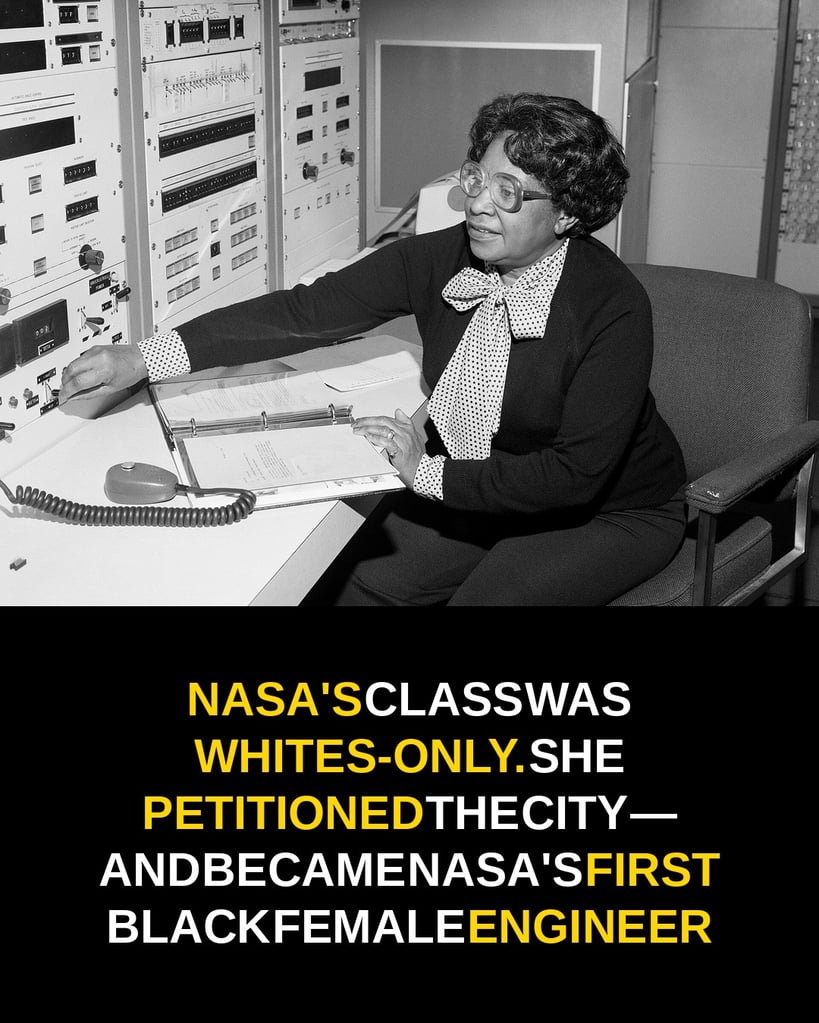
The classes she needed were held at a whites-only high school. The rule wasn’t NASA’s rule — it was the city’s, and it stood between Mary Jackson and the engineer title her work had already earned. So she petitioned the City of Hampton for permission to sit in that classroom. She won. In 1958, she became NASA’s first Black female engineer.
Mary Jackson joined the agency — then called NACA — at Langley in 1951, as a “computer” in the segregated West Area Computing unit, doing the mathematics flight research ran on. Working with engineer Kazimierz Czarnecki in the Supersonic Pressure Tunnel, she was encouraged to qualify as an engineer. She had the talent and the experience. What she needed was the coursework.
The coursework was the trap. The required night classes were held at segregated Hampton High School — closed to her by the city’s segregation, not by any question of ability. Many careers ended quietly at exactly that kind of administrative wall. Jackson’s didn’t, because she treated the wall as a petition, and petitions can be won.
1958: the title the work deserved
She got her permission, attended the classes, completed the coursework — and in 1958 became the agency’s first Black female engineer, the title her tunnel work had merited for years. She went on to author or co-author more than a dozen research reports: the engineer’s record, in print, under her own name.
Think about what the petition really was. It wasn’t a shortcut or a favor. It was a woman forcing a segregated city to let her earn, in a classroom she was barred from, a credential she then used at the highest level of American flight research. Every barrier in her path had paperwork behind it. She answered with paperwork of her own — and won.
The second career: opening doors
And then Jackson did the thing this page honors most. In 1979, she stepped into running Langley’s Federal Women’s Program, and spent her final years at the agency pushing open hiring and promotion for women and minorities across NASA, until her retirement in 1985.

The first Black female engineer in NASA’s history used her last years there as an administrator of opportunity — systematically widening, for people she would never meet, the exact pipeline she once had to petition a city to enter. She didn’t just go through the door. She took a job holding it.
NASA’s headquarters in Washington, D.C. now bears her name. The woman Hampton made ask permission to attend night school has her name on the agency’s front door.
Join the conversation
She had to PETITION A CITY to sit in a classroom her work had already earned. Did you know Mary Jackson’s story before the movies — and which part stays with you: the petition, the 1958 title, or the years she spent holding the door? Tell us below.
Source note: Mary Jackson’s account — joining the agency (then NACA) at Langley in 1951 as a “computer” in the segregated West Area Computing unit; working with engineer Kazimierz Czarnecki in the Supersonic Pressure Tunnel and being encouraged to qualify as an engineer; the required night classes being held at segregated Hampton High School; her petition to the City of Hampton for permission to attend, which she won; completing the coursework and becoming the agency’s first Black female engineer in 1958; authoring or co-authoring more than a dozen research reports; running Langley’s Federal Women’s Program from 1979 and pushing open hiring and promotion for women and minorities until her 1985 retirement; and NASA’s Washington, D.C. headquarters bearing her name — is from the NASA biography, via Smithsonian Magazine, and the Science Museum (London) biography. The 1958 framing follows NASA’s own: 1958 is the year NACA became NASA.
Tell us in the comments below - we read every single one, and the best takes get featured.