For seven years I believed I knew how we lost Calla. Then my oldest sat me down in the laundry room and told me I had been grieving a story that never existed.
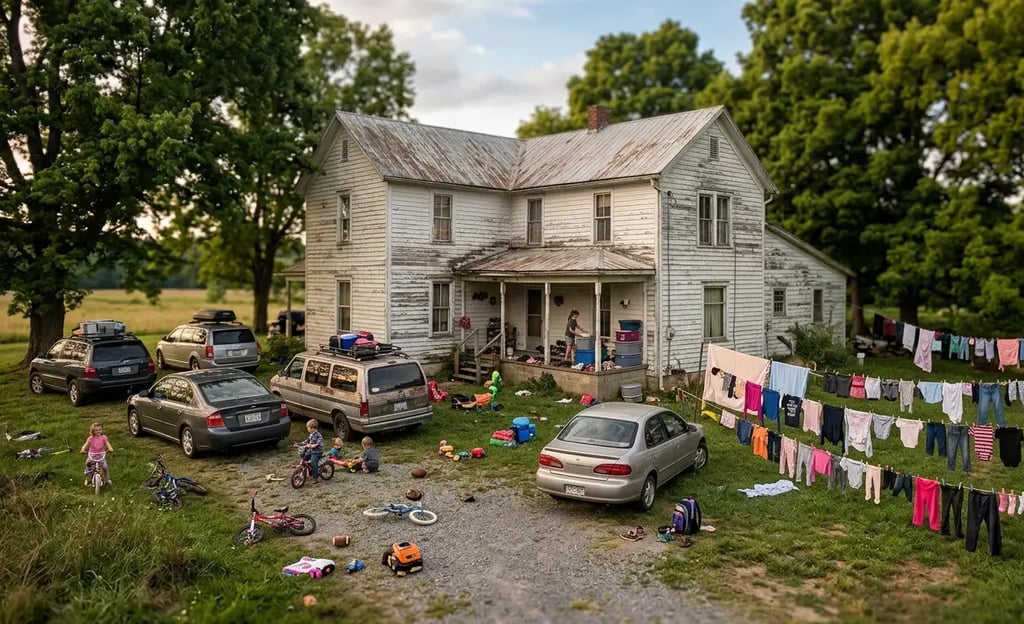
I am forty-four, and for the past seven years I have been raising ten children on my own. None of them is biologically mine. They were my fiancée Calla’s children, and after their mother disappeared, there was nobody else who was going to keep them together — so I became their legal guardian, and this loud, messy house became home.
People ask why I stayed. The answer has never changed: because they were Calla’s, and because those kids had already lost one parent. I was not going to become the second.
The Scene at the Bridge
Seven years ago, police found Calla’s car parked beside the bridge over the river outside town. The driver’s door stood open. Her purse was on the passenger seat. Her coat was folded neatly on the railing above the water. It looked carefully arranged — almost like a scene meant to tell a particular story — but in a small town, people do not wait for answers. They invent their own.
Her eldest, Mara, was found hours later, wandering miles away, barefoot along a quiet road, soaked and shivering. For weeks she answered every question the same way: she did not remember. Everyone assumed trauma.
Search crews spent ten days on the river. Nothing. No body, no answers. The town held a funeral anyway, and we buried an empty coffin. My brother said plainly that I could not raise ten grieving children by myself. But walking away was never an option, so we carried on — birthday after birthday, school concert after soccer game.
“Mom Didn’t Jump. She Left.”
A few weeks ago, over the school-lunch assembly line in our kitchen, Mara asked if we could talk later. That night, after the younger children were asleep, she found me folding towels, closed the laundry-room door, and finally said it: I had been told the wrong story. Her mother had not jumped, and had not fallen. She had left.
Piece by piece, Mara laid out what she had carried since she was eleven. Calla had driven to the bridge on purpose and staged every detail — the car, the purse, the folded coat — to look like a tragedy. She told Mara she was buried in debts she could not repay, that there was another man waiting, and that the family would be better off without her. Then she asked her eleven-year-old daughter to keep the secret, forever.
For seven years Mara watched her brothers and sisters cry themselves to sleep, watched me stand at an empty grave, and stayed silent because she believed that was what her mother wanted. No child should ever have to live with that.
The Message, the Meeting, and the Lawyer
Mara told me now because, three weeks earlier, Calla had messaged her — a photo of a grayer, unsmiling woman beside a man I did not know, a short note saying she was unwell and wanted to explain before it was too late, and a hope that Mara would help her reconnect with the family.
The next morning I did not call Calla. I called a lawyer, who explained that after seven years as the children’s legal guardian, Calla could not simply return with an apology — there would be legal steps, court hearings and evaluations. Hearing that, I finally felt the children were protected.
I did agree to meet Calla, on neutral ground, in a shopping-centre parking lot. She said she had panicked, that the debt and shame had become too much — and then said she had left because she knew I would be a better parent than she could ever be. The truth back was simple: a better parent does not disappear, does not let her children believe she is dead, and does not hand an eleven-year-old a lie to protect for seven years.
Telling the Children
At home, I went to Mara first and told her she did not have to carry it anymore — that she never should have. Then I gathered everyone in the living room and told them the simple truth they deserved: their mother had not died; she had chosen to leave. I left out the debts and the other man — those belonged to Calla’s story, not theirs — and made one thing clear: Mara had been a child asked to keep an impossible secret, and if anyone deserved compassion that night, it was her. Some of the older kids were furious, one stormed outside, another cried — but nobody blamed Mara. One by one, they hugged her instead.
Later, on the back porch, Mara asked what would happen if her mother came back. I told her that being a mother is not just giving birth once; it is something you choose every day — the school mornings, the sleepless nights, the appointments, the moments you are exhausted and stay anyway. Family is built by the people who keep showing up. For seven years we thought tragedy had broken this family. That night we understood what had really held it together: not the person who walked away, but the people who stayed.
Source note: Original story via ViralStrange (https://viralstrange.com/mother-disappeared-for-7-years/). Retold in our own words for Critical Content; story as originally narrated, not independently verified.