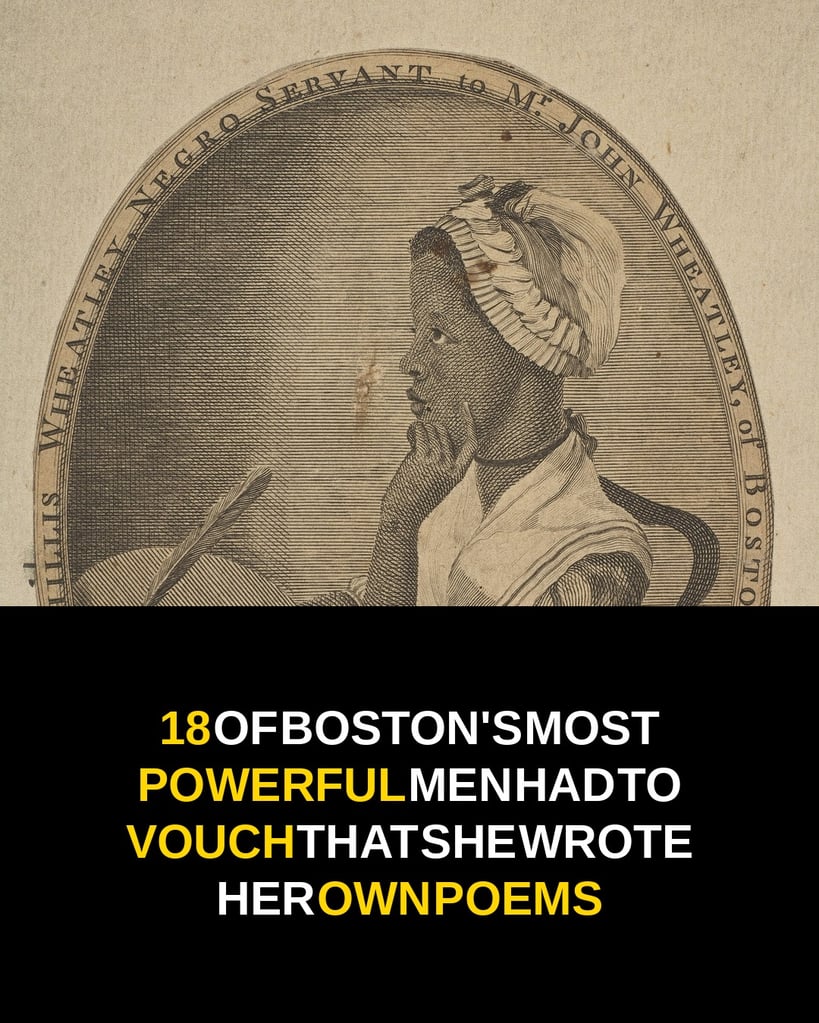
Before the world would let her publish her own poems, she had to pass an examination. In 1772, eighteen of Boston’s most prominent men — including the governor — questioned an enslaved African teenager and signed a public statement swearing the poems were really hers. It remains the most backhanded book blurb in American history, and she earned every word of it.
Start with how she got to Boston. Phillis Wheatley was kidnapped from West Africa as a small child and arrived in Boston on July 11, 1761, aboard the slave ship Phillis — the vessel she was named for — enslaved in the household of John Wheatley. A stolen child, named after the ship that stole her.
And she wrote. Her 1770 elegy on the preacher George Whitefield made her name on both sides of the Atlantic. But fame brought a problem that talent alone couldn’t solve: when she had enough poems for a book, few white readers believed an enslaved African girl could have written them.
The examination
So in 1772 she was examined — by 18 of Boston’s most prominent men, including Governor Thomas Hutchinson and John Hancock, who signed a public attestation that the poems were hers. Sit inside that scene for a moment. The most powerful men in Massachusetts, assembled as a credibility panel for a teenage girl they did not consider fully human under their own laws, because the alternative — that she simply wrote them — was the one conclusion their worldview couldn’t file.
Even with the attestation, no Boston publisher would print the book. It appeared in London, on September 1, 1773 — Poems on Various Subjects, Religious and Moral — when she was about 20 years old.

Print the achievement precisely, because precision is her due: she was the first African American author to publish a book of poetry. (Another Black poet, Jupiter Hammon, had published a poem as a broadside in 1761 — a single broadside sheet, not a book. The book is hers, first, and it matters to say it exactly.)
She was emancipated shortly after returning to Boston that fall. The name that outlived the ship, the household, the examination and the attestation is the one on the book’s cover — hers.
Join the conversation
She had to be EXAMINED by 18 men — the governor among them — to be believed the author of her own mind. Did you learn Phillis Wheatley’s name in school? And a stolen child named for a slave ship put her own name on a book in 1773 — what does that say to you? Tell us below.
Source note: Phillis Wheatley’s account — kidnapped from West Africa as a small child and arriving in Boston on July 11, 1761 aboard the slave ship Phillis, the vessel she was named for, enslaved in the household of John Wheatley; her 1770 elegy on the preacher George Whitefield making her name on both sides of the Atlantic; the 1772 examination by 18 of Boston’s most prominent men, including Governor Thomas Hutchinson and John Hancock, who signed a public attestation that the poems were hers; no Boston publisher printing the book; its London publication on September 1, 1773 as Poems on Various Subjects, Religious and Moral, when she was about 20, making her the first African American author to publish a book of poetry; and her emancipation shortly after returning to Boston that fall — is from the Massachusetts Historical Society (Mass Moments), the 1773 London edition’s front matter, and the University of London. The claim is printed precisely — first book of poetry — because Jupiter Hammon had published a poem as a broadside in 1761, and the attestation had 18 signatories (one modern blog’s figure of nineteen is wrong).
Tell us in the comments below - we read every single one, and the best takes get featured.