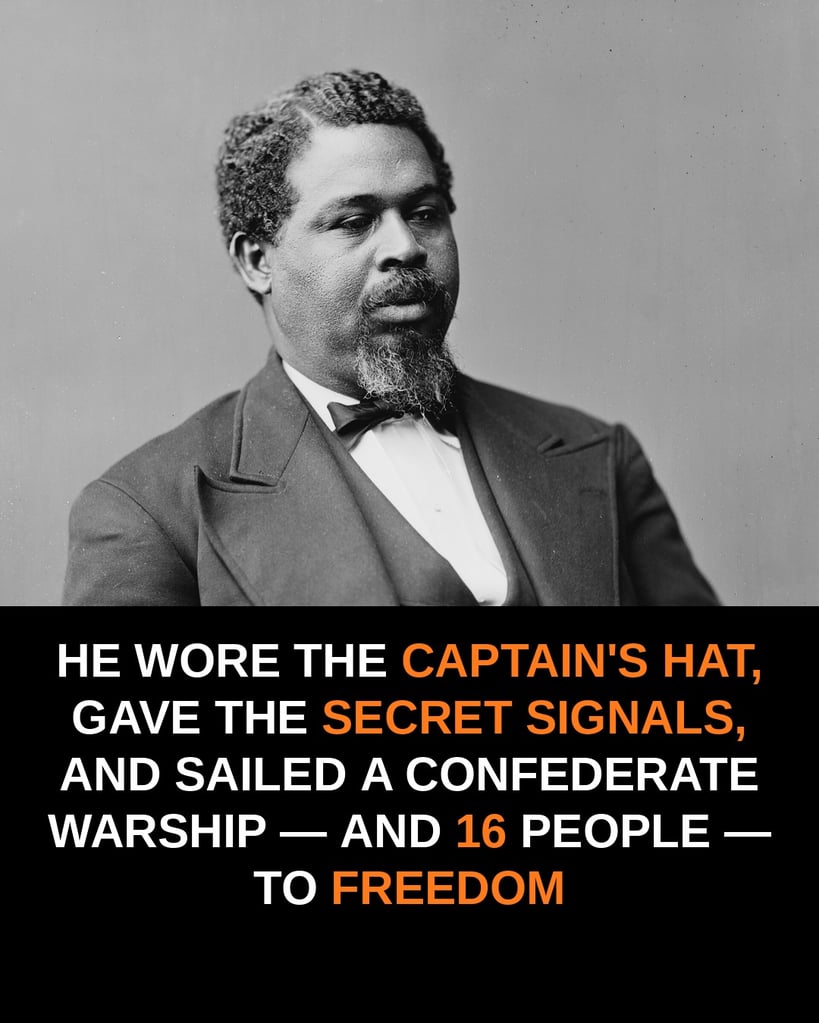
Before dawn, an enslaved man put on the captain’s hat, took the wheel of a Confederate warship, and bluffed his way past Fort Sumter with the correct secret signals — flying a white bedsheet at the end to surrender a stolen ship to freedom. Sixteen people walked off that vessel free.
It is one of the most audacious escapes in American history, and it was not a dash or a scramble. It was a plan — executed calmly, in the captain’s own silhouette, under the guns of the Confederacy. The man at the wheel was Robert Smalls.
May 13, 1862: the officers go ashore
Before dawn on May 13, 1862, in Charleston Harbor, the white officers of the Confederate steamer CSS Planter were ashore. The ship — its guns, its cargo, its crew — sat in the hands of the enslaved men who actually ran her.
Smalls was the Planter’s pilot. He knew the harbor, he knew the checkpoints, and he knew the coded signals the checkpoints demanded. Knowledge the Confederacy had put in his head to serve them was about to be used to rob them.
He took the ship.
The hat, the signals, the bedsheet
The details are why this story has lived for more than 160 years.
To pass as the captain at a distance, Smalls wore the captain’s wide-brimmed straw hat — so that anyone watching from shore or from a fort would see the familiar silhouette at the wheel and wave the ship through.
Checkpoint after checkpoint, including Fort Sumter itself, challenged the Planter — and Smalls gave the correct coded signals. Every bluff landed. The ship steamed out of the harbor it was built to defend.
He stopped to pick up his wife Hannah and their children. And at the Union blockade, the crew swapped the Confederate flag for a white bedsheet — the surrender signal that kept Union guns from firing on them.

Then Smalls delivered the whole prize to the U.S. Navy: the ship, its guns, and a Confederate code book. Sixteen people won their freedom that morning.
Sixteen. Count what that means. Not one man running alone, but families — his own wife and children among them — carried out of slavery on a stolen warship, by a man who had memorized the enemy’s passwords as part of his bondage and spent them, all at once, on freedom.
The life that followed the heist
A lesser story ends at the blockade. Smalls’s was just starting.
He went on to captain the Planter in Union service — the stolen ship, now his to command for the side he had delivered it to. He fought in 17 battles. He helped launch South Carolina’s public school system. He served five terms in Congress.
And then there is the ending no novelist would dare invent: Smalls bought the Beaufort house of the man who had enslaved him.
Read that arc again. Enslaved pilot. Thief of a warship — in the eyes of the men who claimed to own him. Captain in Union service. Congressman, five times over. And finally, homeowner — in the enslaver’s own house, bought fair and owned outright.
The hat trick in Charleston Harbor was not a desperate gamble by a man with nothing to lose. It was the first move of a man who spent the rest of his life building — schools, laws, a career, a legacy — on the freedom he had sailed himself into before dawn.
Join the conversation
The hat. The secret signals past Fort Sumter. The white bedsheet. The congressman’s career — and buying the enslaver’s house. Which part of Robert Smalls’s story hits YOU hardest — and why isn’t this taught everywhere the Mayflower is? Tell us below.
Source note: Robert Smalls’s seizure of the CSS Planter before dawn on May 13, 1862 — taking the ship while its white officers were ashore, wearing the captain’s wide-brimmed straw hat to silhouette himself at the wheel, giving the correct coded signals past checkpoints including Fort Sumter, picking up his wife Hannah and their children, swapping the Confederate flag for a white bedsheet at the Union blockade, and delivering the ship, its guns and a Confederate code book to the U.S. Navy, with sixteen people winning their freedom — and his later life (captaining the Planter in Union service, fighting in 17 battles, helping launch South Carolina’s public school system, serving five terms in Congress, and buying the Beaufort house of the man who had enslaved him) are drawn from the National Endowment for the Humanities, Smithsonian Magazine, and University of South Carolina history.
Tell us in the comments below - we read every single one, and the best takes get featured.