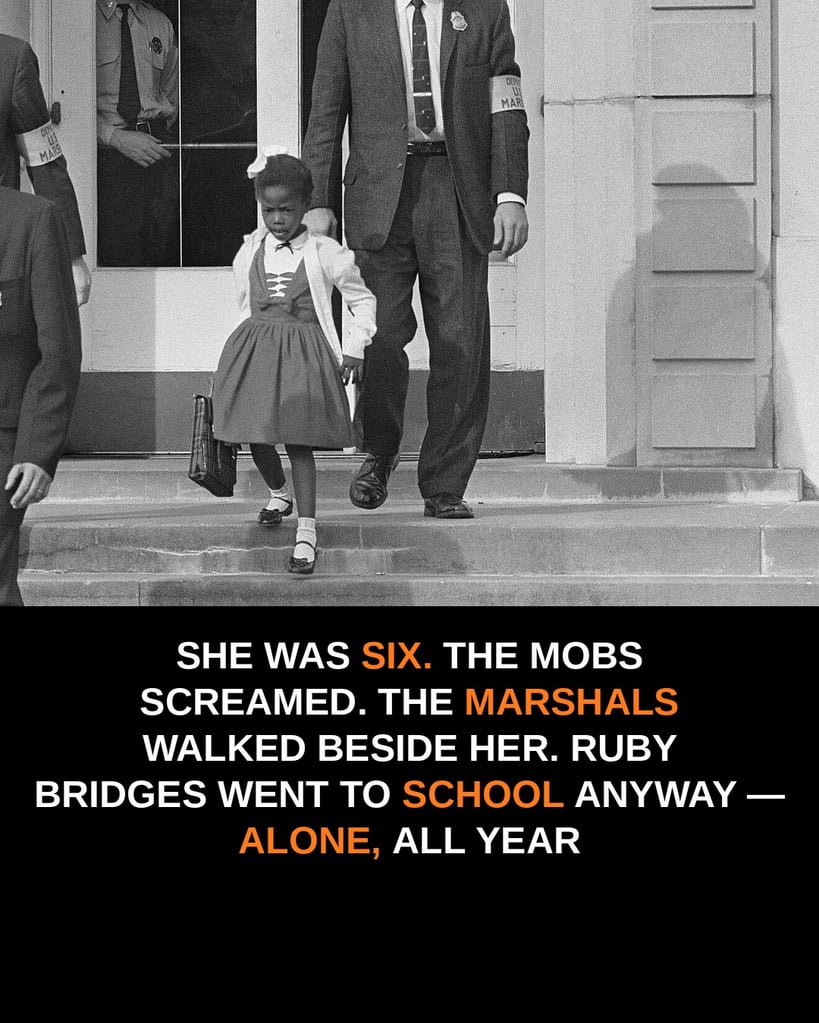
Six years old. A white dress, a small backpack, and four federal marshals — walking straight through a screaming mob to the front door of an elementary school that did not want her there.
November 14, 1960. New Orleans. Ruby Bridges became the first Black child to attend all-white William Frantz Elementary School. She did not walk in with a class. She did not walk in with friends. She walked in alone, escorted by U.S. Marshals, past adults who were shouting at a first-grader for the crime of going to school.
The walk, told straight
That morning, the crowd outside Frantz was not protesting a policy in the abstract. They were screaming at a six-year-old girl by name, carrying signs, and making threats loud enough that the federal government had decided she needed armed escorts to enter a public school. The famous photograph — Ruby in her white dress, flanked by tall men in suits — is not a symbol. It is a record of what a child was made to walk through to claim a right the Supreme Court had already affirmed.
Inside, it did not get easier. White parents pulled their children out of the school rather than let them sit in a classroom with her. So Ruby Bridges spent her entire first-grade year as the only student in her classroom — one teacher, Barbara Henry, teaching one six-year-old girl, all year long.
Read that again slowly: alone, all year. Not a week. Not until things calmed down. An entire school year, because the adults around her chose absence over integration, and the institution let them. The loneliness was not an accident of the story. It was the story — the price of being first, charged daily to a child.
What she carried that year
Ruby Bridges did not have the language of movements or court cases. She had a lunchbox, a classroom, and a teacher who stayed. Barbara Henry, the one white teacher at Frantz who agreed to teach her, taught Ruby alone in that room — and in doing so became part of the story too: the adult who did not walk away.

And Ruby kept showing up. Day after day, through the mobs at the gate and the empty desks around her, she showed up. That is the part the photographs can’t fully capture — not just one brave morning, but a whole year of mornings, each one a decision by a six-year-old to keep walking in.
Why we tell it exactly
It is tempting to soften this story into a poster: a brave little girl, a bad old time, a happy ending. Don’t. The facts resist softening, and they should. She was six. The mobs were real. The marshals were necessary. The classroom was empty of other children for a year because grown adults chose it that way.
Natural Hair Rules tells stories about Black girls and women being seen, and Ruby Bridges is the root of that story — a Black girl whose very presence in a classroom was treated as a threat, who went anyway, and who later spent her life making sure children understand what that walk cost and what it opened. The school she integrated is a place of pilgrimage now. The child who walked in alone grew up to be the woman who walks children through the story herself, so they never have to learn it from a poster alone.
She was six. She went anyway. Alone, all year — and she never stopped going.
Join the conversation
When did you first learn Ruby Bridges’s story — and did anyone tell you she spent the whole year alone in that classroom? Share what you remember below.
Source note: Ruby Bridges’s first day at William Frantz Elementary on November 14, 1960, escorted by four federal marshals, and her year taught alone by Barbara Henry after white parents withdrew their children, are documented by the National Park Service and the Ruby Bridges Foundation; her status as the first Black child to integrate the all-white school is per the same sources.
Tell us in the comments below - we read every single one, and the best takes get featured.