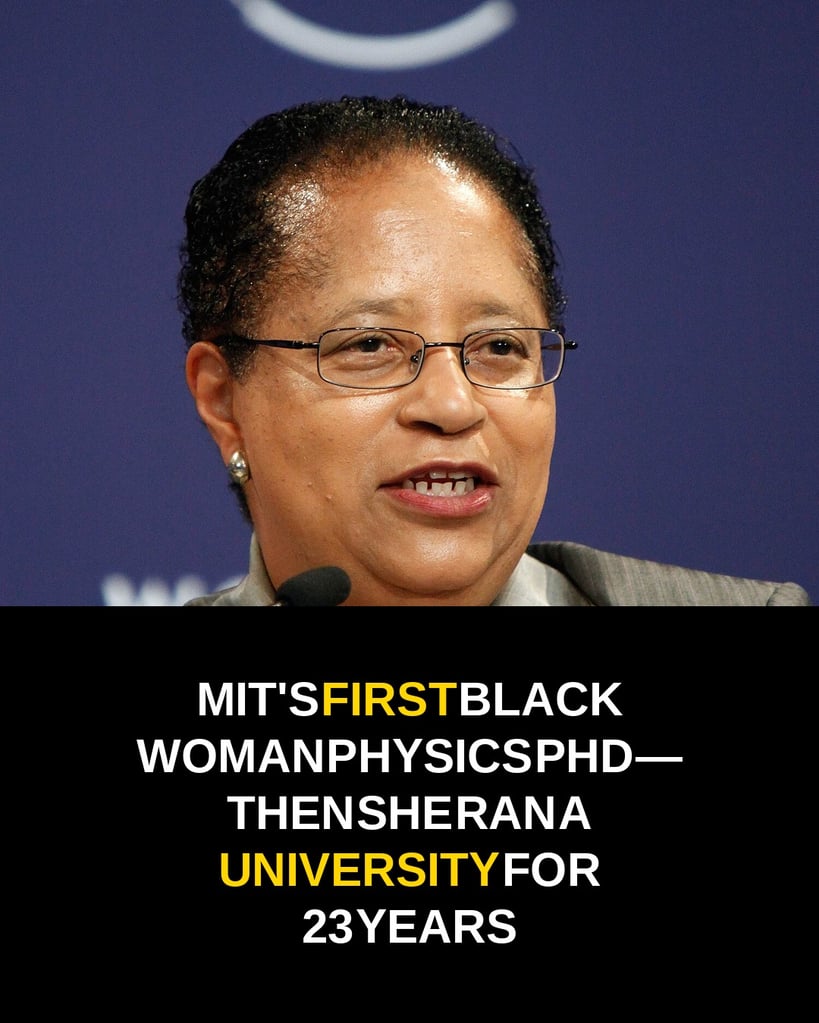
In 1973, Dr. Shirley Ann Jackson becomes the first Black woman to earn a doctorate from MIT — in any field. She goes on to chair the U.S. Nuclear Regulatory Commission, the first woman and the first African American to hold that post, and to lead Rensselaer Polytechnic Institute for 23 years. Her career keeps setting firsts, and each one is documented the same careful way: degree, appointment, years served.
Dr. Shirley Ann Jackson was born on August 5, 1946, in Washington, D.C. She earns her bachelor’s at MIT in 1968, and in 1973 she earns her doctorate there — becoming the first Black woman to earn a doctorate from MIT in any field, and only the second Black woman in the United States to earn a Ph.D. in physics.
Read those two firsts carefully, because they are stated exactly. First Black woman to earn a doctorate from MIT, in any field — not one department, the whole institute. And second Black woman in the country to earn a Ph.D. in physics. A career that begins at that level does not need exaggeration at any later stage, and this profile does not add any.
From Bell Labs to the nation’s nuclear watchdog
After postdoctoral work at Fermilab and CERN, Jackson spends 1976 to 1991 at Bell Labs, researching the physics of semiconductors and two-dimensional electron systems. That is her laboratory record, stated as the record states it: foundational research in semiconductor physics, over fifteen years.
Then, in 1995, President Clinton appoints her chair of the U.S. Nuclear Regulatory Commission — the first woman and the first African American to hold the post. The commission is the nation’s nuclear watchdog, the body charged with overseeing nuclear safety, and Jackson leads it as its chair. A physicist who began with two historic firsts at MIT now holds a federal first as well.
Notice the through-line, because it is the real story. Semiconductor theory at Bell Labs. The chair of the Nuclear Regulatory Commission. This is a career built on deep technical command being trusted, step by step, with larger and larger responsibility.
Twenty-three years leading a university
In 1999, Jackson becomes president of Rensselaer Polytechnic Institute — the first woman and the first African American to lead it — and she serves for 23 years. She led RPI for 23 years: a run measured not in a term or two, but in more than two decades at the head of one institution.
Twenty-three years is its own kind of record. Appointments make headlines for a day. Serving 23 years means a generation of students passes through an institution under one leader’s tenure. First at MIT as a student. First at the Nuclear Regulatory Commission. First at RPI, for 23 years. The pattern never really breaks.
In 2016, President Obama presents her with the National Medal of Science. It is a fitting shape for the honour: the nation’s medal for science, presented to a scientist whose own firsts began with a doctorate nobody who looked like her had earned at MIT before.
Dr. Shirley Ann Jackson’s record, kept exact, needs no additions: MIT, 1968 and 1973. Bell Labs, 1976 to 1991. The Nuclear Regulatory Commission chair, from 1995. RPI, led for 23 years from 1999. The National Medal of Science, 2016.
Join the conversation
First at MIT, first at the Nuclear Regulatory Commission, first at RPI — had you heard Dr. Shirley Ann Jackson’s name before today? Tell us below.
Source note: Dr. Shirley Ann Jackson’s story — Dr. Shirley Ann Jackson (born August 5, 1946, Washington, D.C.); her bachelor’s at MIT in 1968 and, in 1973, becoming the first Black woman to earn a doctorate from MIT in any field and only the second Black woman in the United States to earn a Ph.D. in physics; postdoctoral work at Fermilab and CERN, then 1976–91 at Bell Labs researching the physics of semiconductors and two-dimensional electron systems; President Clinton appointing her chair of the U.S. Nuclear Regulatory Commission in 1995, the first woman and the first African American to hold the post; becoming president of Rensselaer Polytechnic Institute in 1999, the first woman and first African American to lead it, and serving 23 years; and President Obama presenting her with the National Medal of Science in 2016 — is from Physics Today / American Institute of Physics, the National Science & Technology Medals Foundation, RPI, and the Minnesota IT (mn.gov) profile. This piece is a profile of a living subject, in present tense; it prints “led RPI for 23 years” for her completed tenure, prints no invention claim beyond the kernel’s Bell Labs framing, and omits honorary-doctorate counts.