
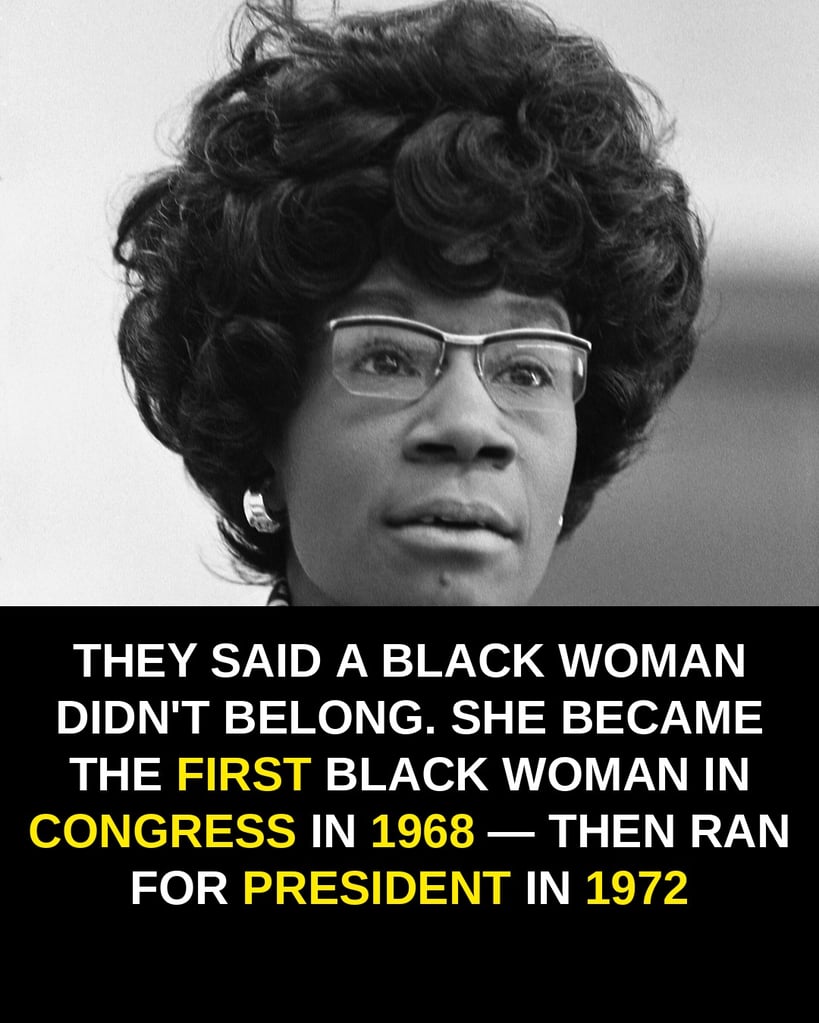
Unbought and unbossed. That was Shirley Chisholm’s slogan — and it was not a branding exercise. It was a description of the woman herself, delivered in an era when almost every door in American politics was closed to someone who looked like her.
In 1968, Shirley Chisholm was elected to the U.S. House of Representatives from New York’s 12th congressional district — Bedford-Stuyvesant, Brooklyn. She was the first Black woman ever elected to Congress. Not appointed. Not seated by accident. Elected, by voters, in a country where women had only held the vote for less than fifty years and Black women in much of the South were still fighting for the right to cast one at all.
She went on to serve seven terms, from 1969 to 1983.
Then she aimed higher — much higher
Most people, having broken one of the hardest barriers in American public life, might have settled into the history books. Shirley Chisholm walked back out and aimed at the highest office on Earth.
In 1972, she ran for President of the United States. The record, stated precisely, is this: she was the first Black candidate to seek a major party’s nomination for President, and the first woman to run for the Democratic Party’s presidential nomination. She campaigned across the country and won 152 delegates.
Understand what she was running against. Not just opponents — an entire architecture of assumptions about who a president could be. She ran anyway, in the open, with her name on ballots, forcing the country to practice saying a sentence it had never said before: a Black woman is running for President.
The barrier-breaker’s tax — and what she bought with it
Firsts pay a tax nobody itemizes. Every room Shirley Chisholm entered, she entered as an argument. Every vote she cast was read as a statement about her race and her sex, not just her judgment. She carried that weight for fourteen years in Congress and a national campaign — and what she bought with it was a map.
Because a barrier, once broken by one person, becomes a route for everyone behind her. Every Black woman who has served in Congress since 1969 walked through a door Shirley Chisholm opened. Every woman who has sought a major party’s presidential nomination since 1972 ran on ground she surveyed first. She did not get to be President. She made it possible for the country to imagine one.
That is what “first” actually means. Not a trophy for the person who carries it — a road for the people who never have to carry it again.
Join the conversation
Be honest: when did you FIRST learn Shirley Chisholm’s name — school, or as an adult, the way most of us did? And which part of her story should every little girl know by heart: the Congress first, or the presidential run? Tell us below.
Source note: Shirley Chisholm’s 1968 election as the first Black woman elected to the U.S. Congress, her representation of New York’s 12th district (Bedford-Stuyvesant, Brooklyn), and her seven terms (1969–1983) are from the National Archives (archives.gov) biography. Her 1972 candidacy is described there and by Encyclopaedia Britannica as making her the first Black candidate to seek a major party’s nomination for President of the United States and the first woman to run for the Democratic Party’s presidential nomination; she won 152 delegates. This article uses the Archives/Britannica wording — she sought a major-party nomination — rather than the looser claim sometimes shared that she “won a nomination.”