
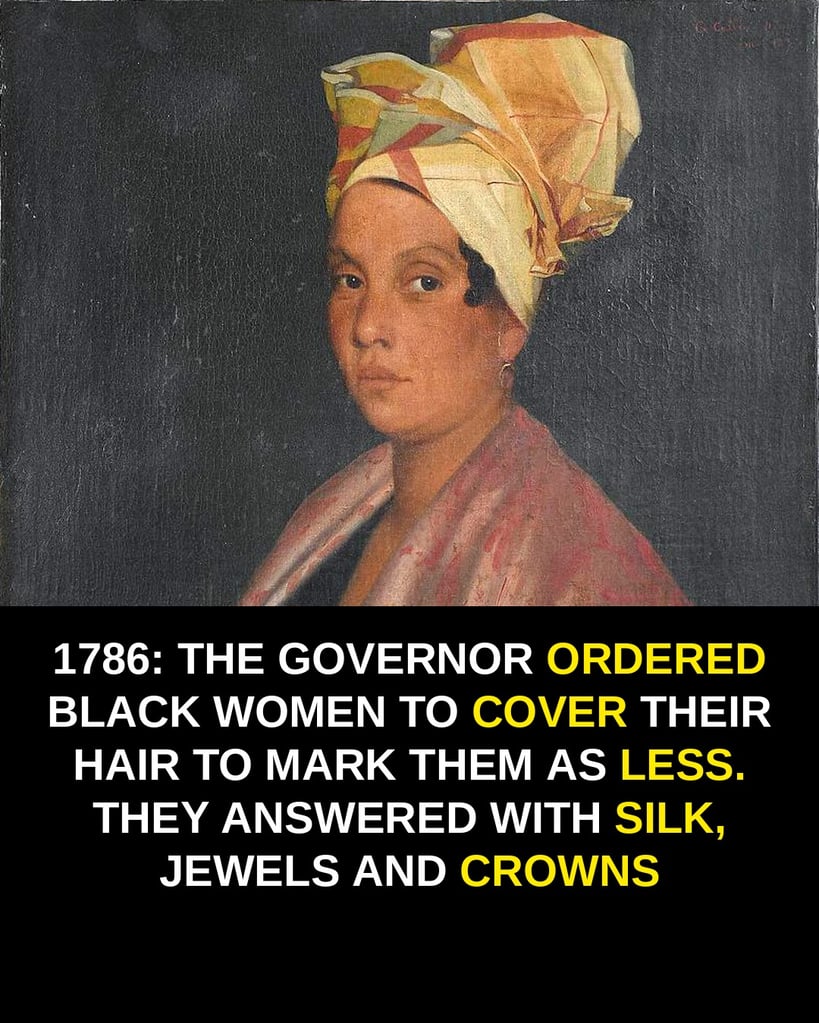
They tried to use a headwrap as a brand — a visible mark that a woman was beneath somebody else. The women of New Orleans took the order, wrapped it in the finest fabric they could find, and wore it like a crown. This is one of the oldest hair fights on record in America, and it started with a governor who felt threatened by how free Black women carried themselves.
On June 2, 1786, Spanish Governor Esteban Rodríguez Miró issued his “proclamation of good government” in New Orleans. Among its rules for women of color — free and enslaved alike — they were forbidden plumes and jewelry, and ordered to bind their hair in a kerchief: the tignon. It was to be worn as a visible badge of the slave class.
Let the design of that cruelty sink in. The order reached past what a woman owned or where she could go. It reached for her hair — the way she adorned herself, presented herself, held her head in public — and tried to make it announce her rank to everyone who passed her on the street.
What the governor was really afraid of
Historian Virginia M. Gould explains Miró’s aim plainly: the order was meant to control women who “competed too freely with white women for status and thus threatened the social order.”
That sentence is the whole confession. The tignon was not about neatness, modesty, or public order. Free women of color in New Orleans were dressing well, adorning themselves, and moving through the city with a presence the hierarchy could not stand — so the hierarchy reached for the one thing it could legislate: their appearance. When a government has to pass a law about your hair, your hair was never the problem. Your freedom was.
The answer they wrapped on their heads
Here is where the story turns — and why it is still told more than two centuries later.
The women complied. Outwardly, they obeyed the letter of the order: hair bound, covered, wrapped. But they complied in the finest fabrics they could get. They wrapped the tignon high and sculptural. They decked it with ribbons and jewels.

The badge of shame became a fashion the whole city copied.
Think about the precision of that defiance. They did not get to refuse the wrap — the law saw to that. So they refused its meaning instead. Every high wrap, every ribbon, every jewel said the same thing without a word: you can order the cloth, but you cannot order what it means. The governor had intended a marker of less-ness. They turned it into plumage he had technically forbidden, worn higher than ever.
A wrap that outlived the law
And the tignon did not disappear when the era that created it did. Later generations kept the wrap as a symbol of pride — from Marie Laveau’s famous seven-knot tignon onward, the headwrap in New Orleans carried memory, identity, and style all at once.
So when you see a sister today wrap her hair high for a photograph, a celebration, a Sunday — know that the gesture has a paper trail. In 1786 a governor tried to make covered hair mean submission. The women of New Orleans answered in silk, and their answer is the one history kept.
Every headwrap since is, whether we say it out loud or not, a reply.
Join the conversation
Did YOU know a governor once made it LAW for Black women to cover their hair — and that the women turned the order into a fashion the whole city copied? And be honest: is the headwrap, to you, protection, style, or pride? Tell us below.
Source note: The Tignon Laws account — Governor Esteban Rodríguez Miró’s “proclamation of good government” of June 2, 1786, forbidding women of color in New Orleans plumes and jewelry and ordering their hair bound in a tignon as a badge of the slave class — is from USC Dornsife’s “The Politics of Bonnets, Headwraps, and Scarves” (2025) and tignon scholarship. Historian Virginia M. Gould’s explanation of Miró’s aim — controlling women who “competed too freely with white women for status and thus threatened the social order” — and the women’s response (fine fabrics, high sculptural wraps, ribbons and jewels, the style copied citywide, and the wrap’s later life as a symbol of pride from Marie Laveau’s seven-knot tignon onward) are from that scholarship (Gould; Long) as carried in reference works. Correction: some retellings date the edict to 1785, the start of Miró’s term — the decree itself was issued in 1786.
Tell us in the comments below - we read every single one, and the best takes get featured.