
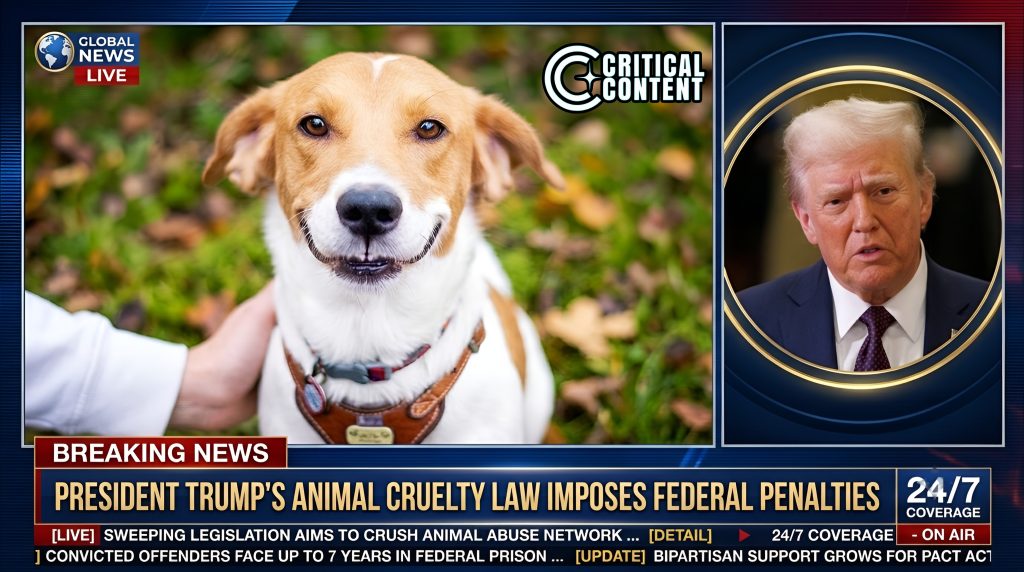
The Preventing Animal Cruelty and Torture (PACT) Act marked a significant expansion of federal animal protection laws in the United States when it was signed into law by then-President Donald Trump in November 2019.
The bipartisan legislation makes certain acts of extreme animal cruelty a federal offense and authorizes penalties of up to seven years in federal prison for those convicted.
Supporters of the law hailed it as an important step in strengthening protections for animals and giving federal authorities additional tools to prosecute severe abuse cases.
What Happened
On November 25, 2019, President Donald Trump signed the PACT Act into law after it passed both chambers of Congress with broad bipartisan support. The Senate approved the legislation by unanimous consent.
The law expands on earlier federal legislation by making it a crime to intentionally engage in or create certain acts of extreme animal cruelty in situations where federal jurisdiction applies.
The PACT Act specifically prohibits knowingly engaging in acts such as:
- Crushing an animal.
- Burning an animal.
- Drowning an animal.
- Suffocating an animal.
- Impaling an animal.
- Other forms of intentional and severe cruelty covered under the statute.
Individuals convicted under the law can face:
- Federal felony charges.
- Fines.
- A prison sentence of up to seven years.
The law generally applies when the offense involves interstate commerce, federal property, or other circumstances that establish federal jurisdiction. It does not replace state animal cruelty laws, which continue to govern most cases.
Background
Before the PACT Act, Congress had passed the Animal Crush Video Prohibition Act of 2010, which made it illegal to create or distribute videos depicting animal crushing.
However, that earlier law primarily targeted the recording and sale of such videos rather than the underlying acts themselves.
The PACT Act closed that gap by criminalizing certain acts of extreme animal cruelty under federal law, even when no video is produced.
Animal welfare organizations, lawmakers from both political parties, and many law enforcement groups supported the legislation, arguing that it strengthened protections against particularly egregious forms of abuse.
Why This Matters

The PACT Act represents an additional layer of protection for animals by allowing federal authorities to prosecute qualifying cases that fall within federal jurisdiction.
Supporters say the law:
- Strengthens enforcement against severe animal cruelty.
- Creates stronger penalties for qualifying federal offenses.
- Complements existing state animal protection laws.
- Demonstrates bipartisan support for animal welfare.
Legal experts note that most animal cruelty investigations are still handled under state and local laws, which often include their own criminal penalties.
Public Reaction
The law received widespread support from lawmakers across the political spectrum, animal welfare organizations, and many members of the public.
Supporters described the legislation as an important step toward holding offenders accountable for severe acts of cruelty.
Many advocacy groups also noted that stronger enforcement can help address crimes that involve organized abuse and other serious offenses.
At the same time, legal experts emphasized that the law has defined limits and applies only in cases where federal jurisdiction exists.
Expert or Wider Context
Animal welfare laws in the United States operate at both the federal and state levels.
Every state has its own statutes addressing animal cruelty, with penalties ranging from misdemeanors to felonies depending on the circumstances.
The PACT Act supplements—not replaces—those state laws by allowing federal prosecution in qualifying cases.
Legal scholars also note that federal criminal statutes are typically reserved for offenses involving interstate commerce, federal lands, or other constitutionally recognized areas of federal authority.
Final Thoughts
The PACT Act expanded federal authority to prosecute some of the most serious forms of animal cruelty and established penalties of up to seven years in prison for qualifying offenses.
Signed into law by President Donald Trump in 2019 after receiving bipartisan support in Congress, the legislation is widely regarded as a milestone in federal animal welfare law.
While most animal cruelty cases continue to be handled by state authorities, the PACT Act provides an additional legal tool for addressing particularly severe acts that fall under federal jurisdiction.
FAQ