
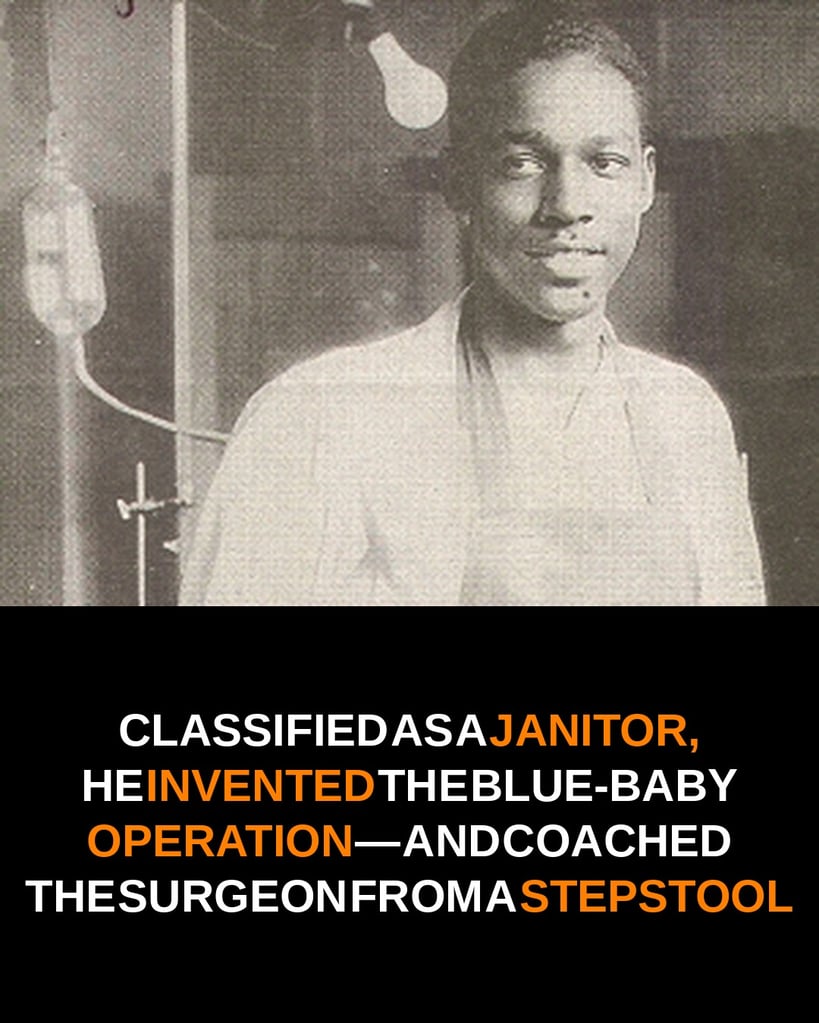
The hospital classified him as a janitor and paid him as a janitor. The work he was doing was postdoctoral-level research that would save babies’ lives around the world. Vivien Thomas — grandson of an enslaved man — developed the blue-baby operation in a laboratory, then stood on a stepstool behind the surgeon and coached him through the first human operation, step by step, because he was the one who actually knew how it was done.
Thomas had lost his college savings in the Depression. In 1930 he was hired as a lab assistant to Dr. Alfred Blalock at Vanderbilt, and when Blalock moved to Johns Hopkins in 1941, Thomas followed. It was at Hopkins that the hospital classified and paid him as a janitor while he did research far beyond that title — a pay stub that tells you everything about the era, and nothing about the man.
The problem he was set to solve was the “blue baby” condition — tetralogy of Fallot, a heart defect that starved babies’ blood of oxygen and turned their skin blue. In the laboratory, over roughly two years of work on about 200 dogs, Thomas created the defect and then corrected it, building the procedure piece by piece with his own hands, down to needles he customized himself.
November 29, 1944: the stepstool
On November 29, 1944, the procedure was attempted on a human patient: 15-month-old Eileen Saxon. Blalock operated. And Thomas stood on a stepstool behind him, coaching him through the procedure step by step — the lab assistant who had invented the operation guiding the famous surgeon’s hands through it in real time.
The operation became world-famous. The celebrated 1945 JAMA paper about it credited Blalock and Taussig only — Thomas’s name appeared nowhere. Read that again. The man on the stepstool, without whom the surgery does not happen, was not in the paper. Modern usage increasingly repairs the record by calling the procedure the Blalock-Thomas-Taussig shunt — his name restored to the operation he built.
Justice came slowly, but it came inside the same walls. Thomas went on to supervise Johns Hopkins’ surgical laboratories for 35 years and to train generations of surgeons — the “janitor” teaching the doctors. In 1971 the hospital hung his portrait. In 1976 it gave him an honorary doctorate and an instructor-of-surgery appointment. He died in 1985, and his story was later told in the HBO film Something the Lord Made.
A portrait, a doctorate and a film are fine things. But the truest sentence in this story is the simplest one: when the first blue baby was opened up in 1944, the expert in the room was standing on a stepstool, and the hospital was paying him to mop.
Join the conversation
How does a story like this change the way you hear the word “janitor” — or any job title used to shrink somebody? And when you say the name of this operation, will you say Blalock-Thomas-Taussig from now on? Tell us below.
Source note: Vivien Thomas (1910–1985) — grandson of an enslaved man, losing his college savings in the Depression, hired in 1930 as a lab assistant to Dr. Alfred Blalock at Vanderbilt and following him to Johns Hopkins in 1941, where the hospital classified and paid him as a janitor while he did postdoctoral-level research; developing the blue-baby procedure over roughly two years of work on about 200 dogs, creating and then correcting the tetralogy of Fallot defect; standing on a stepstool behind Blalock and coaching him step by step through the first human operation on Nov 29, 1944, on 15-month-old Eileen Saxon, using needles he had customized himself; the celebrated 1945 JAMA paper crediting Blalock and Taussig only, with Thomas’s name appearing nowhere, while modern usage increasingly calls it the Blalock-Thomas-Taussig shunt; his supervising Johns Hopkins’ surgical laboratories for 35 years and training generations of surgeons; the hospital hanging his portrait in 1971 and giving him an honorary doctorate and an instructor-of-surgery appointment in 1976; and his death in 1985, with his story told in the HBO film Something the Lord Made — is from the American College of Cardiology and Johns Hopkins Medicine profiles.

