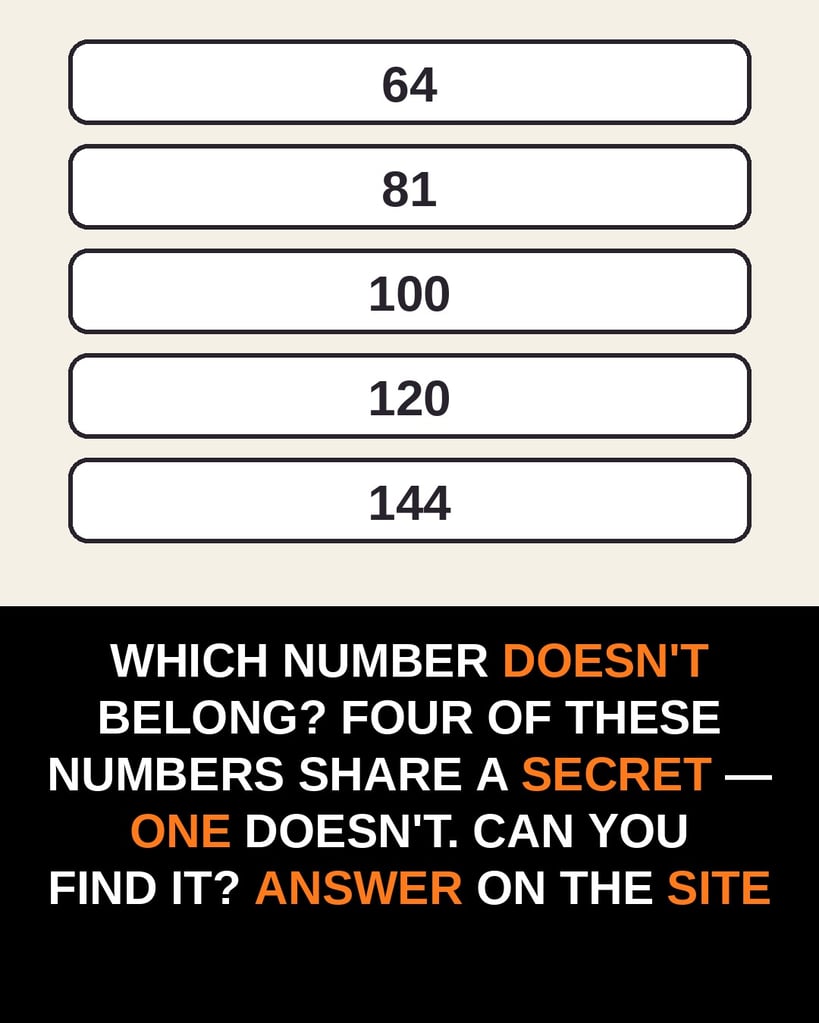
The answer is 120.
The five numbers were: 64 · 81 · 100 · 120 · 144. Four of them share one hidden property: each is a perfect square — a whole number multiplied by itself.
- 64 = 8 × 8 = 8²
- 81 = 9 × 9 = 9²
- 100 = 10 × 10 = 10²
- 144 = 12 × 12 = 12²
- 120 = …nothing × nothing. There is no whole number that squares to 120.
Here’s the near-miss that makes it certain: the sequence of squares runs 8², 9², 10², then 11² = 121, then 12². The set skips straight past where 11² should sit — and 121 is the closest square to 120, off by exactly one. 120 falls in the gap between 100 and 121, a non-square surrounded by squares.

That makes 120 the only number of the five that isn’t a perfect square — a unique answer, provable with four multiplications. Did you spot the squares pattern, or were you hunting through odd and even? Tell us below.
Tell us in the comments below - we read every single one, and the best takes get featured.