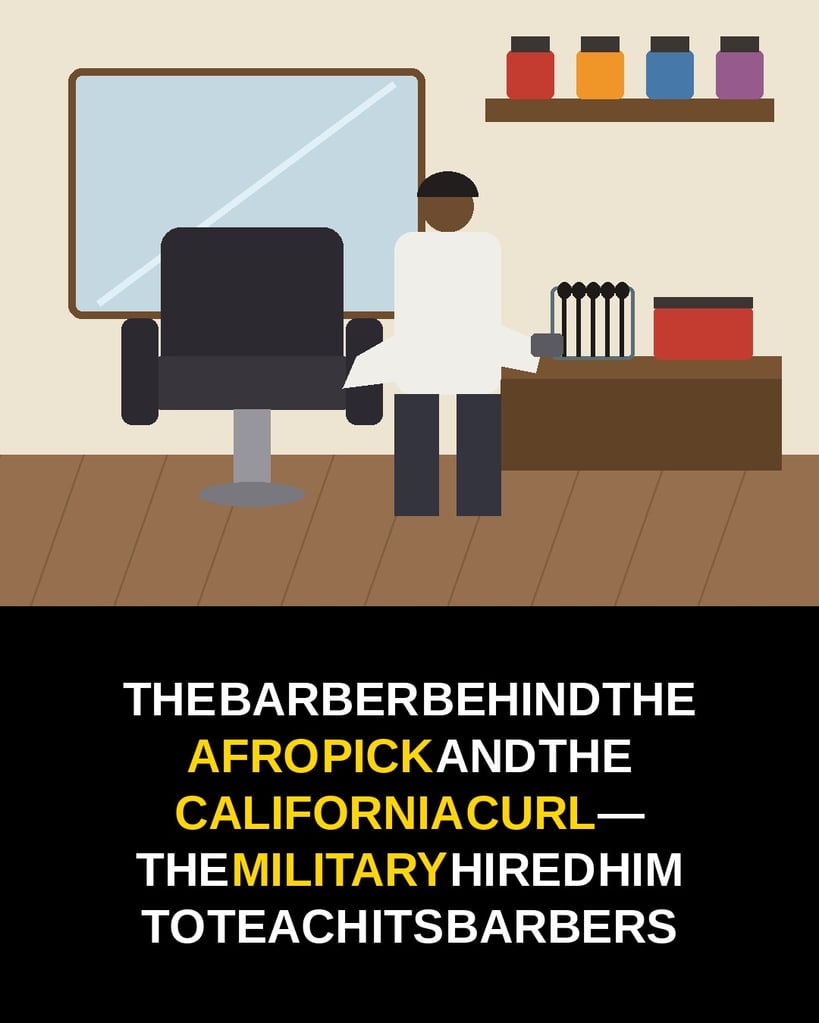
He was born to a sharecropper family in Alabama. He opened a barbershop in San Diego, helped put the Afro pick in hands across America, created the California Curl — and then the United States military called him in to teach its own barbers how to cut Black soldiers’ hair.
Willie Lee Morrow was born on October 9, 1939, in Tuscaloosa, Alabama, to a sharecropper family. His beginning could hardly have been further from an empire. But Morrow built his life around a chair, a pair of clippers, and a clear understanding of what Black hair needed — and what the beauty industry had failed to give it.
In 1959, he opened his first barbershop in San Diego. That shop was the foundation. From behind that chair, Morrow watched styles change, listened to what his customers wanted, and started creating the tools and products they could not find anywhere else. A barber who invents is a powerful thing, because he is solving problems he sees with his own eyes, every single day.
The pick and the curl
Morrow is credited with popularizing the Afro pick — the wide-toothed pick that became inseparable from the Afro itself. As the Afro grew into a proud, towering statement, Black people needed a tool made for lifting and shaping natural hair without tearing it apart. The pick Morrow popularized answered that need, and it became far more than a grooming tool. It became a symbol you could hold in your hand.
Then came the California Curl, the at-home curl process Morrow created. The California Curl was the direct forerunner of the Jheri curl era — the process that showed a soft, glossy curl could be done at home, and inspired what followed. To be clear about the credit: the Jheri curl itself was Jheri Redding’s later product. Morrow’s California Curl came first, and it paved the road the Jheri curl later traveled.
The military called him
In 1969, the call that proved his standing came from an unexpected place: the U.S. Department of Defense hired him to travel to military bases and teach barbers how to cut Black soldiers’ hair. Think about what that means. The American military, with all its resources, looked for the expert on Black hair — and the expert was a sharecropper’s son running a barbershop in San Diego.
He did not stop at hair, either. Morrow also founded the San Diego Monitor newspaper and a radio station, building a small Black media-and-beauty empire in San Diego. Barbering, products, a newspaper, a radio station — he understood that a community needs its hair cared for and its own voice heard, and he built for both.
Willie Morrow died on June 22, 2022, at 82. The pick in the back pocket, the curl that changed an era, the barbers on military bases finally learning to cut the soldiers in their chairs — that is a legacy built one head at a time, by a man who started with almost nothing and taught a country how it was done.
Join the conversation
Did you grow up with an Afro pick in the house — and did you know the California Curl came before the Jheri curl, not from it? Be honest: had you ever heard Willie Morrow’s name before today? Tell us below.
Source note: Willie Lee Morrow’s story — born October 9, 1939, in Tuscaloosa, Alabama, to a sharecropper family, and died June 22, 2022, at 82; his first San Diego barbershop opened in 1959; he is credited with popularizing the Afro pick; he created the California Curl, the at-home curl process that was the direct forerunner of the Jheri curl era (the Jheri curl itself was Jheri Redding’s later product); in 1969 the U.S. Department of Defense hired him to travel to military bases and teach barbers how to cut Black soldiers’ hair; and he founded the San Diego Monitor newspaper and a radio station, building a small Black media-and-beauty empire in San Diego — is from NPR, Los Angeles Times coverage via Because of Them We Can, Ebony, and BlackDoctor.