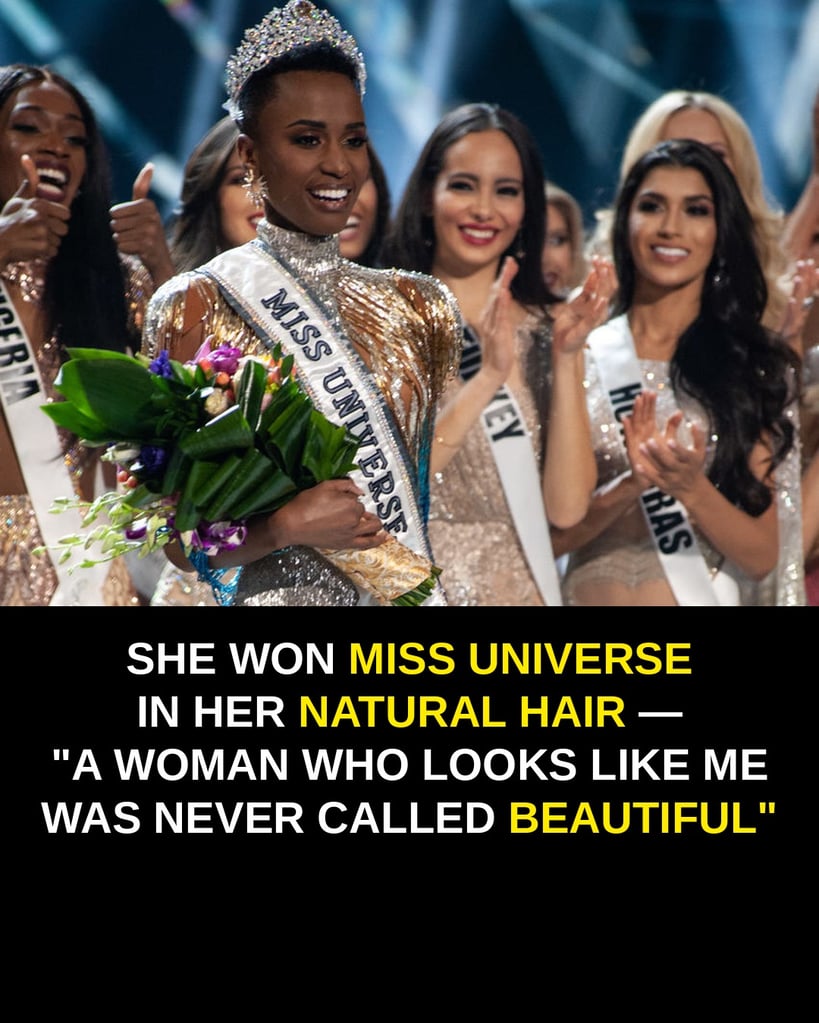
She didn’t straighten it. She didn’t weave it, wig it, or tuck it into anybody’s idea of pageant hair. On December 8, 2019, in Atlanta, Zozibini Tunzi walked onto the Miss Universe stage in her own short natural hair — and walked off with the crown.
Tunzi, 26, representing South Africa, became Miss Universe in front of a global audience, exactly as she was. For women who have ever been told their hair had to change before they could be called beautiful, it was not just a pageant result. It was a verdict reversed on live television.
“A symbol of my firm belief in fair representation”
Her natural style was not an accident or a last-minute styling choice. Tunzi described her hair as “a symbol of my firm belief in fair representation” — a deliberate statement that the standard itself, not the women failing to meet it, was the problem.
Understand what she was up against. Miss Universe is one of the oldest beauty institutions on Earth, and for most of its history its visual language was unmistakable: long, flowing, straightened or loosely waved hair. Contestants from Africa learned the same lesson contestants everywhere learned — if you want the crown, your hair should move a certain way.
Tunzi refused the lesson. She kept her hair short and natural through the competition, and the crown came to her hair — her hair did not have to go anywhere.
The closing statement heard around the world
Then came the moment that turned a win into a landmark. In her closing statement, Tunzi said the words that have been quoted ever since:
“I grew up in a world where a woman who looks like me — with my kind of skin and my kind of hair — was never considered to be beautiful. I think it is time that stops today.”
Read that again slowly. She did not say she had proven the world wrong about her. She said the world’s definition was finished — time’s up on it. “I think it is time that stops today” is not a hope. It’s a deadline, delivered by the woman holding the microphone and, minutes later, the crown.
She was the pageant’s first Black winner in eight years, since Leila Lopes in 2011 — a drought that itself tells you how narrow the doorway had been.
Why this one lives on a natural hair page
This is our story at the highest possible altitude. Every woman here knows a version of the math Zozibini refused: the job interview hair, the picture-day hair, the “professional” hair, the hair you wear so the room will listen to you. She took the biggest beauty stage on the planet and declined to do that math in public — and won anyway, as herself, with her kind of skin and her kind of hair.
Little girls watched that crowning. Some of them are wearing their hair exactly as it grows today because a Miss Universe went first.
Join the conversation
Where were you when she said “it is time that stops today”? And tell us honestly — what room in YOUR life still makes you feel like your hair has to change before you walk in? Below. 👇
Source note: Zozibini Tunzi’s crowning on December 8, 2019 in Atlanta, her description of her natural hair as “a symbol of my firm belief in fair representation,” her closing statement, and her status as the pageant’s first Black winner since Leila Lopes (2011) are from NPR, “Miss Universe 2019 Is Young, Gifted And An Outspoken Believer In ‘Black Girl Magic’” (Dec 9, 2019), quoting her official Miss Universe bio. One correction this page is careful about: Tunzi was NOT the first South African winner, as some blogs claim — she was the third, after 1978 and 2017.