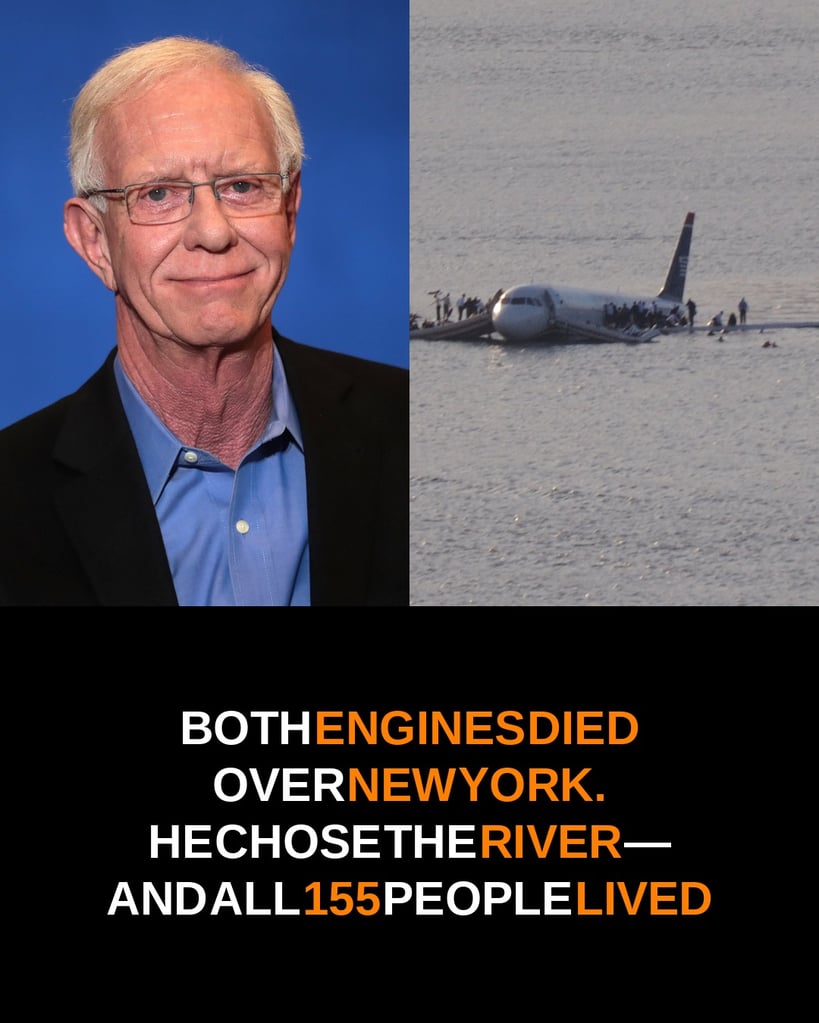
Ninety seconds after takeoff, at roughly 2,800 feet over New York, the plane hit a flock of Canada geese — and both engines went quiet. No runway could be reached. So the captain chose the only surface left: the Hudson River. On January 15, 2009, all 155 people aboard Flight 1549 lived to tell about it.
The flight was a US Airways Airbus A320 out of LaGuardia, bound for Charlotte. In the cockpit: Captain Chesley “Sully” Sullenberger, 57, a former Air Force fighter pilot with 19,663 flight hours, and First Officer Jeffrey Skiles. When the geese took out thrust in both engines, the two men did the coldest math in aviation — altitude, distance, options — and judged they could not reach any runway.
What they reached instead was the river. At 3:31 p.m., the A320 ditched in the Hudson off Midtown Manhattan — an airliner, set down on water, in one piece, by hand.
All 155
Say the number the way it deserves to be said: all 155 people aboard — 150 passengers and 5 crew — survived. They stood on the wings of a floating airliner in a January river and were rescued by ferries and boats that converged on the scene. Not a single life lost, in a scenario that flight training treats as nearly unsurvivable.
And credit it the way the investigation did: to the whole crew. Sullenberger and Skiles in the cockpit, the three flight attendants who got 150 people out of a sinking cabin, and the ferry crews who became a rescue fleet in minutes. The NTSB investigation vindicated the crew’s decision — one board official called it “the most successful ditching in aviation history.”

A note for honesty’s sake, because this page checks: the 2016 film about the flight dramatizes the investigation as hostile to Sully. The NTSB and Sullenberger himself pushed back on that portrayal. The real investigation’s verdict was vindication — the drama didn’t need inventing, and neither does this story.
The lesson in the 90 seconds
What the Hudson landing really demonstrates is what preparation looks like when it’s invisible. Nineteen thousand flight hours don’t show in a crisis — judgment does. Two pilots, given about ninety seconds of altitude and no engines, spent none of it panicking and all of it deciding. The river wasn’t luck. It was the last correct answer on a list of wrong ones, chosen calmly, by a crew that worked as one.
155 people went home that night because of it.
Join the conversation
Do you remember where you were when the Miracle on the Hudson happened? And be honest: 90 seconds, no engines, no runway — what do you think separates the people who decide clearly in a moment like that? Tell us below.
Source note: The Flight 1549 account — January 15, 2009; the US Airways Airbus A320 departing LaGuardia for Charlotte; striking a flock of Canada geese about 90 seconds out at roughly 2,800 feet and losing thrust in both engines; Captain Chesley “Sully” Sullenberger (57, former Air Force fighter pilot, 19,663 flight hours) and First Officer Jeffrey Skiles judging no runway reachable and ditching in the Hudson River off Midtown Manhattan at 3:31 p.m.; all 155 aboard (150 passengers, 5 crew) surviving and being rescued from the wings by ferries and boats; and the NTSB investigation vindicating the crew’s decision, with one board official calling it “the most successful ditching in aviation history” — is from NTSB accident report DCA09MA026 and contemporaneous reporting (January 2009). The 2016 film’s portrayal of the investigation as hostile was disputed by the NTSB and Sullenberger himself, and is noted here for accuracy.
Tell us in the comments below - we read every single one, and the best takes get featured.