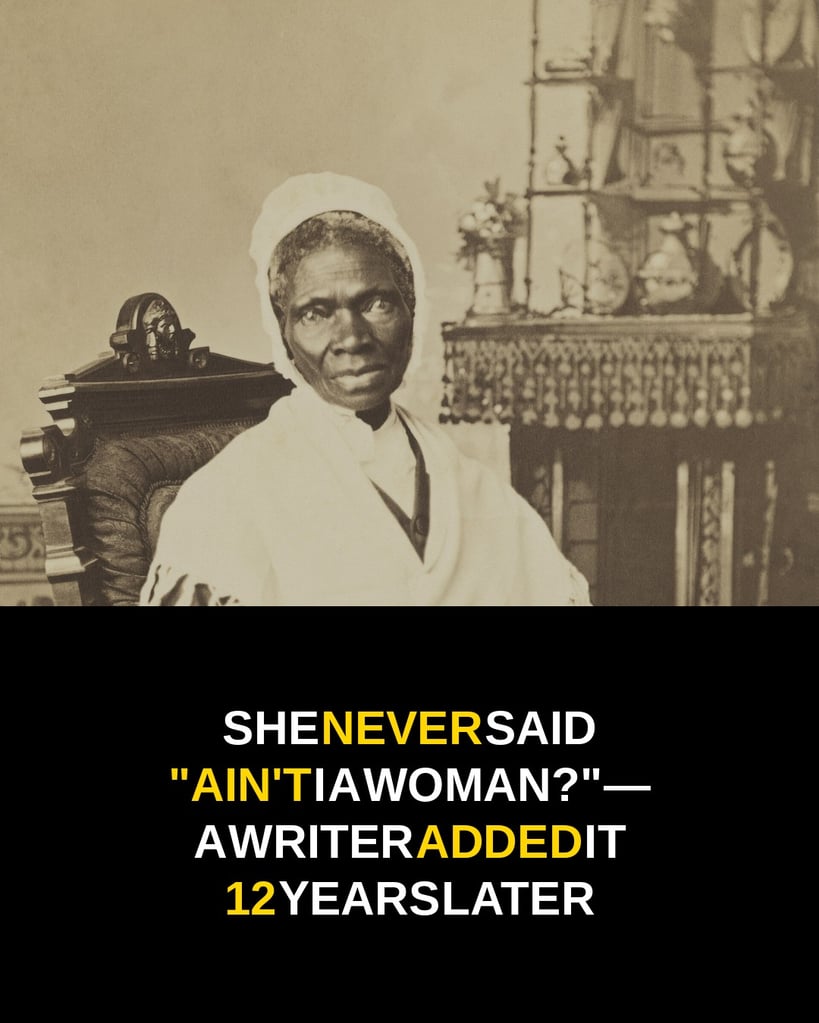
It may be the most famous line ever put in a Black woman’s mouth: “Ain’t I a Woman?” There’s just one problem — in the fullest account of the speech, written down by the convention’s own recording secretary and reviewed with Sojourner Truth herself, those words never appear. A writer added them 12 years later, along with a dialect Truth never spoke and children she never had. This page corrects the record, because her documented words are strong enough.
Sojourner Truth really did speak at the Women’s Rights Convention in Akron, Ohio, on May 29, 1851 — rising uninvited, improvising, in a hall that had not planned on hearing from her. That part of the legend is true. What she said is where the legend takes over.
What the contemporary record says she said
The fullest contemporary account was published June 21, 1851, in the Anti-Slavery Bugle by Marius Robinson — the convention’s recording secretary, who went over his transcription with Truth herself. Here is her argument, in the version she reviewed:
“I am a woman’s rights. I have as much muscle as any man, and can do as much work as any man. I have plowed and reaped and husked and chopped and mowed, and can any man do more than that?”
No refrain. No “Ain’t I a Woman?” — not once, because in Robinson’s account it isn’t there at all. What is there is better than a refrain: a laborer’s evidence, itemized. Plowed. Reaped. Husked. Chopped. Mowed. She doesn’t ask the room a rhetorical question; she presents a work record and dares anyone to beat it.
What Gage added in 1863
The famous version was published by Frances Dana Gage on April 23, 1863 — nearly 12 years after the speech. Gage added the “Ain’t I a Woman?” refrain, four times over. She added a Southern plantation dialect. And she added a claim of “thirteen children… most all sold off to slavery.”

None of it fits the woman. Truth was born Isabella Baumfree in Ulster County, New York. She spoke Dutch until she was about nine years old. She never spoke in a Southern dialect in her life. And she had five children — not thirteen.
Historian Nell Irvin Painter’s 1996 biography established Robinson’s account as the reliable one, and the National Park Service presents both versions and notes the discrepancy. The famous speech, as the world quotes it, is substantially a white writer’s 1863 reconstruction of what an 1851 audience should have heard.
Why the correction honors her more
Some will say the famous version did good in the world, and maybe it did. But a page that celebrates Black women’s voices cannot let a rewritten voice stand when the real one survives. Truth’s documented words don’t need a dialect coach or an invented refrain. A woman born enslaved in New York, who taught herself freedom’s argument, stood up uninvited and made her case out of her own worked fields — and the secretary who wrote it down checked his notes with her.
Quote that woman. She’s magnificent enough.
Join the conversation
Be honest: is “Ain’t I a Woman?” the version you were taught? And hearing her documented words — the plowed, reaped, husked, chopped, mowed work record — do you find the REAL speech weaker, or stronger? Tell us below.
Source note: The Sojourner Truth account — her rising uninvited and speaking extemporaneously at the Women’s Rights Convention in Akron, Ohio on May 29, 1851; the fullest contemporary account by Marius Robinson, the convention’s recording secretary, who reviewed his transcription with Truth herself, published June 21, 1851 in the Anti-Slavery Bugle, containing her words (“I have plowed and reaped and husked and chopped and mowed, and can any man do more than that?”) and no “Ain’t I a Woman?” refrain; Frances Dana Gage’s version published April 23, 1863 in The Independent, adding the refrain, a Southern plantation dialect, and “thirteen children”; Truth’s birth as Isabella Baumfree in Ulster County, New York, speaking Dutch until about age nine, and having five children; and Nell Irvin Painter’s 1996 biography establishing Robinson’s account as the reliable one, with the National Park Service presenting both versions and noting the discrepancy — is from the Anti-Slavery Bugle (June 21, 1851), Gage’s version in The Independent (April 23, 1863), Nell Irvin Painter, Sojourner Truth: A Life, a Symbol (1996), and the National Park Service.
Tell us in the comments below - we read every single one, and the best takes get featured.