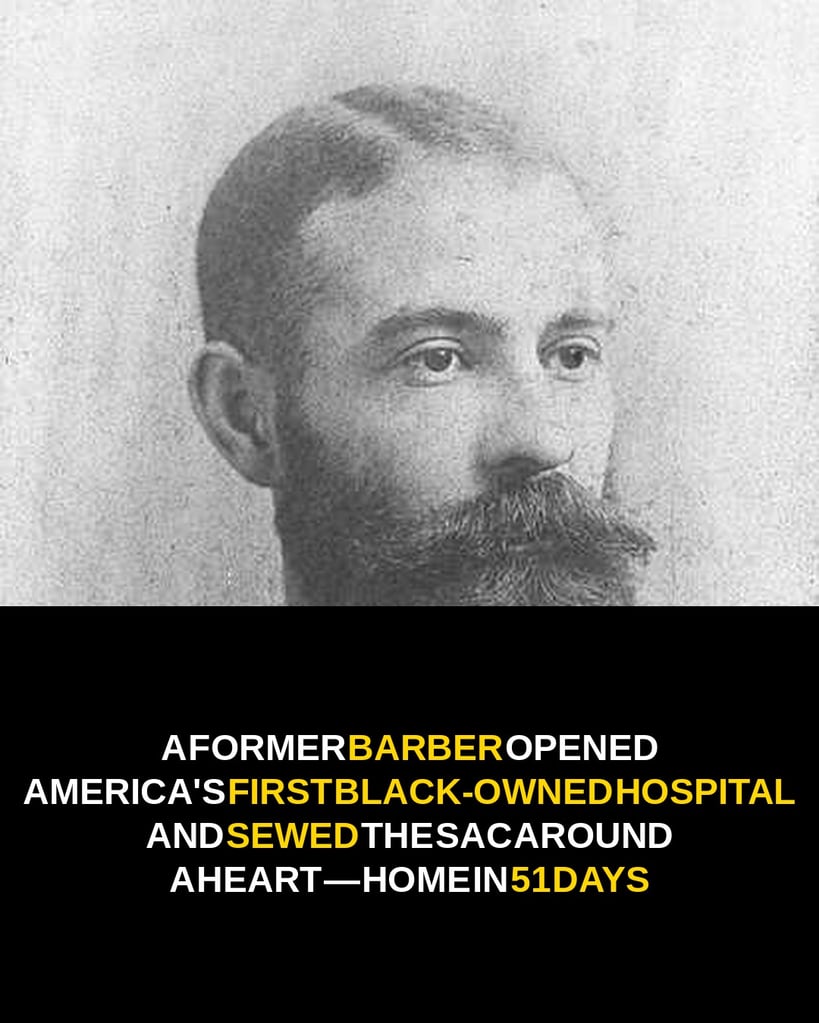
He apprenticed as a shoemaker. He worked as a barber, like his father before him. Then Daniel Hale Williams earned a medical degree, built America’s first Black-owned hospital with his own hands and vision — and one summer night in 1893, with a dying man on the table and six doctors watching, he opened a chest and performed one of the first successful operations on the heart.
Williams was born in 1856, the son of a barber. He apprenticed as a shoemaker and worked as a barber himself before turning to medicine, earning his MD in 1883. At that time he was one of only about three Black doctors practicing in all of Chicago. He could have built a quiet, comfortable practice. Instead, he looked at what Black patients and Black medical students were being shut out of — and decided to build the institution himself.
The hospital he built
On May 4, 1891, Williams founded Provident Hospital and Training School for Nurses — the first Black-owned and -operated hospital in America. And he built it deliberately interracial, in both staff and patients, at a time when segregation was the rule almost everywhere else. Provident was also the first hospital in the United States with nursing and intern programs open to Black students, training the very people the rest of the system refused to teach.
Two years later came the night that made his name permanent. On the night of July 9–10, 1893, a stabbing victim named James Cornish was brought into Provident dying. Before six observing doctors, Williams opened Cornish’s chest, repaired a severed artery, and sutured the torn pericardium — the sac around the heart. Read that carefully, because this page prints it the honest way: Williams operated on the sac around the heart, not the heart muscle itself, and his operation was one of the first successful operations on the heart — a similar pericardium repair had been performed in St. Louis in 1891. What no honest framing can take away is the result: Cornish was discharged 51 days later, and he lived more than 20 additional years.
A career that kept opening doors
The operation was one night. The institution-building was a lifetime. In 1894 Williams became chief surgeon of Freedmen’s Hospital in Washington. He was a charter member of the National Medical Association, and in 1913 he became the first Black charter fellow of the American College of Surgeons — honors that recognized what Provident had already proven: that a Black-founded, interracial hospital could stand with any hospital in the country.
Williams died in 1931. But walk the line of his life once more: shoemaker’s apprentice, barber, one of three Black doctors in Chicago, founder of a hospital, surgeon who sewed the sac around a dying man’s heart and sent him home to live two more decades. He didn’t wait for a door to open. He built the building the door was in.
Join the conversation
Be honest — had you ever heard Dr. Daniel Hale Williams’s name before today, or did his story reach you as a myth somebody had to correct first? And how many other founders do you think built whole institutions that history filed under somebody else’s name? Tell us below.
Source note: Daniel Hale Williams’s story — the son of a barber who apprenticed as a shoemaker and worked as a barber before earning his MD in 1883, when he was one of only about three Black doctors then practicing in Chicago; founding Provident Hospital and Training School for Nurses on May 4, 1891, the first Black-owned and -operated hospital in America, deliberately interracial in staff and patients and the first U.S. hospital with nursing and intern programs open to Black students; the night of July 9–10, 1893, when stabbing victim James Cornish was brought in dying and, before six observing doctors, Williams opened his chest, repaired a severed artery and sutured the torn pericardium, with Cornish discharged 51 days later and living more than 20 additional years; becoming chief surgeon of Freedmen’s Hospital in Washington in 1894; charter membership in the National Medical Association; and becoming in 1913 the first Black charter fellow of the American College of Surgeons — is from Columbia University Department of Surgery, American Heart Association News, and PBS. This page prints “one of the first successful operations on the heart” deliberately: a similar pericardium repair was performed in St. Louis in 1891 (H.C. Dalton), and Williams operated on the sac around the heart, not the heart muscle itself.