
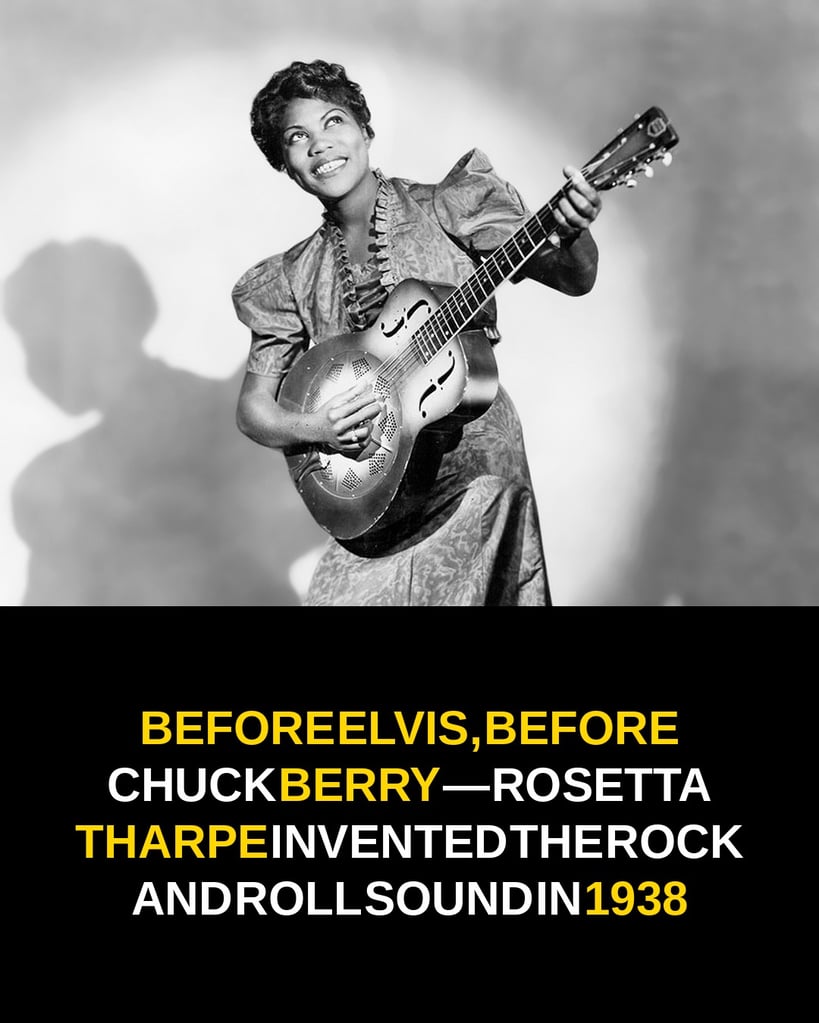
Before Elvis had a record, before Chuck Berry had a guitar style, a gospel singer from Cotton Plant, Arkansas was already playing the sound the world would later name rock and roll — loud electric guitar, driving beat, and all. Her name was Sister Rosetta Tharpe, and the men who got the crowns spent their careers standing in her light.
Born Rosetta Nubin on March 20, 1915, in Cotton Plant, Arkansas, Tharpe signed with Decca in 1938 — and what a year 1938 was for her. She performed at Carnegie Hall’s historic “From Spirituals to Swing” concert. And she released her first single, “Rock Me”: gospel lyrics carried over a driving beat with heavy electric-guitar distortion, years before “rock and roll” had a name. Church words, juke-joint engine. Nobody had put them together like that, at that volume, with that attack on the strings.
Understand what she was risking. A gospel singer with an electric guitar that loud was stepping across a line her own church world watched carefully — sacred on one side, secular on the other. Tharpe played on both sides of it and made the crossing itself sound joyful. The guitar wasn’t decoration. It was a lead voice, bending and driving, and every guitarist who followed had to reckon with it.
The 1944 record the historians keep pointing back to
In 1944 she recorded “Strange Things Happening Every Day,” with pianist Sammy Price. In April 1945 it reached No. 2 on Billboard’s “race records” chart — the first gospel record ever to cross over to the R&B chart. And here is where this page prints the claim the careful way: that record is cited by many historians as a candidate for the first rock and roll record. Print it as the attributed claim it is — many historians, a candidate — because the honest version is strong enough. A gospel record, by a woman with an electric guitar, sitting near the top of the R&B chart in 1945.
The influence is not a matter of debate at all. She was a direct influence on Elvis Presley, Chuck Berry, Little Richard and Johnny Cash — read those four names again and understand that rock and roll’s founding generation is, in part, her student body.
And the honor? It waited. The Rock & Roll Hall of Fame finally inducted Sister Rosetta Tharpe in 2018 — 45 years after her death on October 9, 1973. Forty-five years late, and still the building had to make room for the woman who was there before the name of the place existed. Before Elvis, before Chuck Berry — there was a sister with a guitar, playing it like she invented it. The historians say she may well have.
Join the conversation
Be honest: the first time you heard Sister Rosetta Tharpe play, did it rearrange your whole picture of where rock and roll came from? And which of her famous students — Elvis, Chuck Berry, Little Richard, Johnny Cash — do you hear her in the most? Tell us below.
Source note: Sister Rosetta Tharpe (born Rosetta Nubin, March 20, 1915, Cotton Plant, Arkansas) — signing with Decca in 1938, performing at Carnegie Hall’s historic “From Spirituals to Swing” concert that year and releasing her first single, “Rock Me,” in 1938, with gospel lyrics over a driving beat and heavy electric-guitar distortion years before “rock and roll” had a name; her 1944 recording “Strange Things Happening Every Day,” with pianist Sammy Price, reaching No. 2 on Billboard’s “race records” chart in April 1945 as the first gospel record ever to cross over to the R&B chart, and being cited by many historians as a candidate for the first rock and roll record (printed as an attributed claim, never settled fact); her being a direct influence on Elvis Presley, Chuck Berry, Little Richard and Johnny Cash; her induction into the Rock & Roll Hall of Fame in 2018, 45 years after her death on Oct 9, 1973 — is from NPR’s “Forebears” series, the Rock & Roll Hall of Fame and the UC Santa Barbara Discography of American Historical Recordings.

