
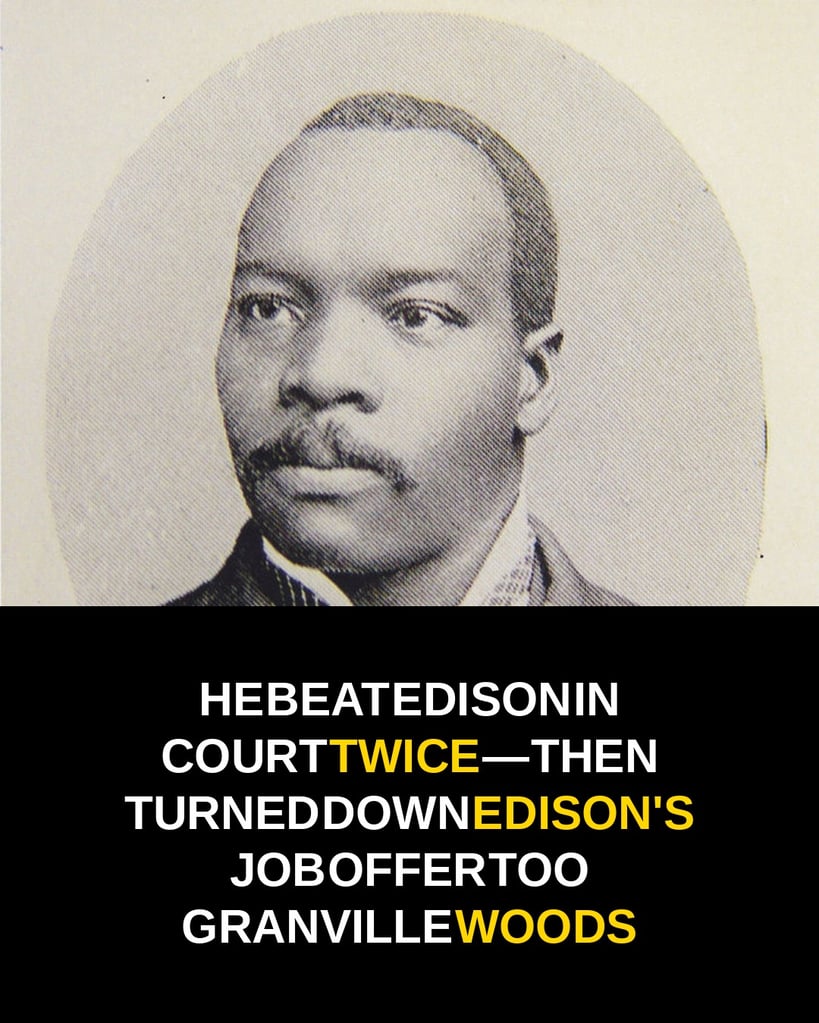
Thomas Edison sued him twice, claiming his invention belonged to Edison. Edison lost both times. Then Edison offered him a job — and Granville Woods said no. That is how good this man was, and how determined he was to stay his own man.
Granville T. Woods was born on April 23, 1856, in Columbus, Ohio. He would go on to hold nearly 60 U.S. patents — invention after invention, across a career spent solving the hard electrical and mechanical problems of a country being wired together. In his own lifetime, people gave him a nickname that tells you the level he was working at: the “Black Edison.”
But nicknames can shrink a man, too. Woods was not a copy of anybody. He was an original mind, and the courtroom record proves it — because when the real Edison tried to claim Woods’s work, judges looked at the evidence and sided with Woods. Twice.
The invention that let trains talk
His best-known invention was the induction telegraph, U.S. Patent 373,383, granted in 1887. It let moving trains communicate with stations and with each other, preventing collisions. Sit with that for a moment. Before this, a train rolling down a track was largely cut off from the world — the station could not warn it, and it could not warn the train behind it. Woods’s system changed that, and changing that saved lives.
This was the invention Edison challenged. Thomas Edison twice sued, claiming the induction telegraph was his — and lost both times. Imagine the pressure: the most famous inventor in America, with his lawyers and his reputation, coming for your patent in court. Woods stood his ground, presented his work, and won. Then he did it again.
The offer he turned down
After losing twice, Edison then offered Woods a partnership and a job. It would have been the safe move — security, money, and the shelter of the Edison name. Woods declined, preferring to stay independent. He had beaten the man in court; he was not about to go work for him. He kept his own name, his own company, and his own direction.
Woods sold inventions to major companies of the day — the big firms of the era bought what he built, because what he built worked. Nearly 60 patents, a courtroom record of two wins against Edison himself, and a refusal to trade independence for comfort: that is a complete picture of an inventor who knew exactly what his mind was worth.
Granville Woods died on January 30, 1910, in New York City. Recognition at the national level came long after his death: he was inducted into the National Inventors Hall of Fame in 2006 — nearly a century later, the institution finally carved his name where it always belonged.
Join the conversation
Be honest: if Edison offered you the job after you beat him twice, would you have taken it — or walked away independent like Woods? And had you ever heard the name Granville Woods before today? Tell us below.
Source note: Granville T. Woods’s story — born April 23, 1856, in Columbus, Ohio, and died January 30, 1910, in New York City; nearly 60 U.S. patents (the National Inventors Hall of Fame’s wording); his induction telegraph (U.S. Patent 373,383, 1887) letting moving trains communicate with stations and with each other, preventing collisions; Thomas Edison twice suing claiming the invention was his and losing both times, then offering Woods a partnership/job, which Woods declined, preferring to stay independent; his sales of inventions to major companies of the day and his lifetime nickname, the “Black Edison”; and his induction into the National Inventors Hall of Fame in 2006 — is from the National Inventors Hall of Fame (invent.org), Atlas Obscura, and Wikipedia (patent-record sourced).