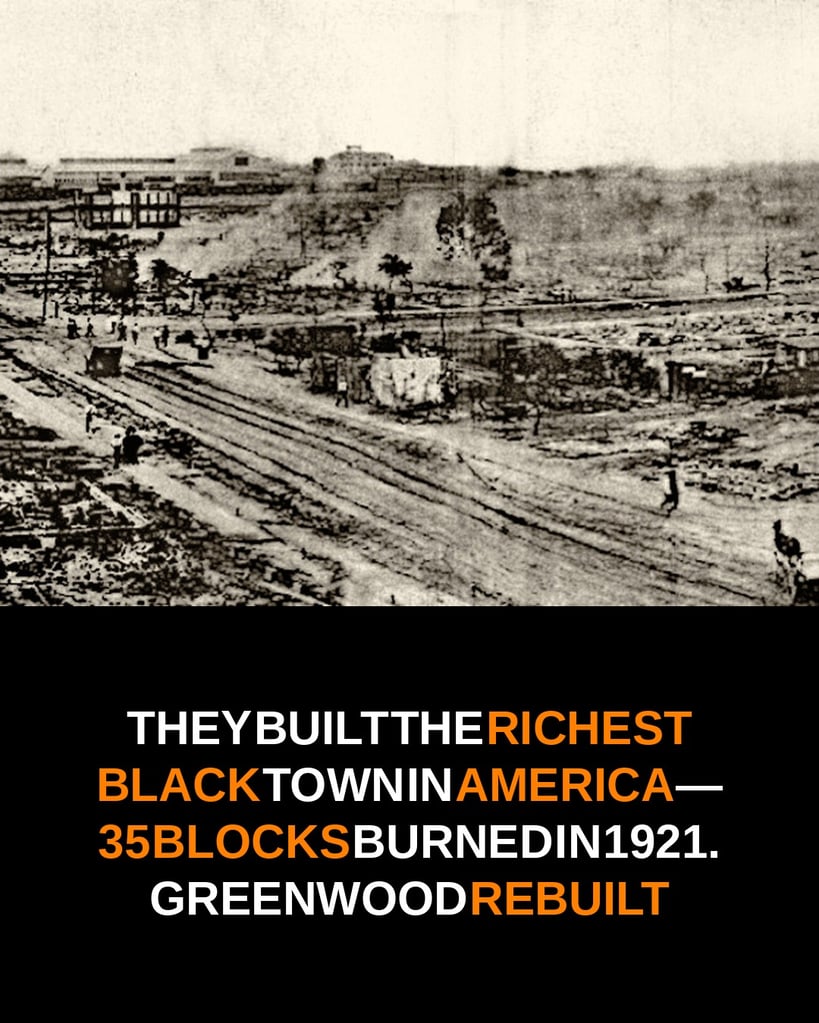
Before the fire, there was the building — and the building is where this story has to start. In Tulsa, Oklahoma, Black families built the richest Black town in America: doctors, lawyers, two newspapers, a hospital, hundreds of businesses on land they owned. It was called Black Wall Street. In 48 hours in 1921, it was burned to the ground. And then — the part too often left off — they rebuilt it.
Tulsa’s Greenwood District held some 10,000 Black residents and hundreds of Black-owned businesses. It had doctors and lawyers, two newspapers and a hospital. It had J.B. Stradford’s hotel — the largest Black-owned hotel in America. This wasn’t prosperity borrowed or granted. It was prosperity constructed, block by block, by a community shut out of so much else and determined to own its own future.
Remember what Greenwood proves before we get to what was done to it: given land, skill and each other’s patronage, Black Tulsa built a complete economy — professional class, press, medicine, hospitality — in a state that had been a state for barely a decade and a half.
May 31 – June 1, 1921
After an elevator incident involving a Black teenager and a white elevator operator, white mobs — some of them deputized by authorities — invaded Greenwood and burned it. In roughly 48 hours: 35 square blocks destroyed. The Red Cross counted 1,256 houses burned and 215 more looted. 191 businesses were lost, along with churches, the school, the library and the hospital. More than 800 people were hospitalized, some 6,000 Black residents were interned, and nearly 10,000 were left homeless.
On the deaths, this page prints the record exactly the way the sources support it — a range, not a single settled number. The official 1921 death toll was 36. A 2001 state commission confirmed 39 documented deaths. Historians estimate the true toll may have been as high as 300. Anyone who hands you one flat number for Tulsa is handing you less than the truth.
No one was ever prosecuted. A 2001 Oklahoma commission recommended reparations. And for generations, the story was largely omitted from Oklahoma classrooms — an erasure layered on top of a burning.
They rebuilt
Here is where we close, because Greenwood’s people chose where the story goes next: within years, residents rebuilt much of the district — on the same ground, under the same sky, with the rubble barely cleared. The people who had built Black Wall Street once built much of it again.
So tell it whole: the wealth was real, the destruction was real, the toll honestly runs from 36 counted to perhaps 300 souls — and the rebuilding was real too. Greenwood was never just a tragedy. It was, first and last, an achievement.
Join the conversation
Be honest: were YOU taught about Greenwood in school — or did you learn Black Wall Street existed as an adult, like so many of us? And which should lead every telling: what they built, what was done to it, or that they built it again? Tell us below.
Source note: The Greenwood record — Tulsa’s Greenwood District holding some 10,000 Black residents and hundreds of Black-owned businesses, with doctors, lawyers, two newspapers, a hospital and J.B. Stradford’s hotel, the largest Black-owned hotel in America, and its renown as “Black Wall Street”; the May 31 – June 1, 1921 attack following an elevator incident involving a Black teenager and a white elevator operator, with white mobs, some deputized by authorities, invading and burning the district; 35 square blocks destroyed; the Red Cross count of 1,256 houses burned and 215 more looted; 191 businesses, churches, the school, the library and the hospital lost; more than 800 people hospitalized, some 6,000 Black residents interned and nearly 10,000 left homeless; the death toll printed only as its sourced range — official 1921 count 36, a 2001 state commission confirming 39 documented deaths, and historians estimating the true toll may have been as high as 300 — never as a single settled figure; no one ever prosecuted; the 2001 Oklahoma commission recommending reparations; the story’s long omission from Oklahoma classrooms; and Greenwood residents rebuilding much of the district within years — is from History.com, Smithsonian Magazine, and Wikipedia’s account of the 2001 Oklahoma Commission findings.