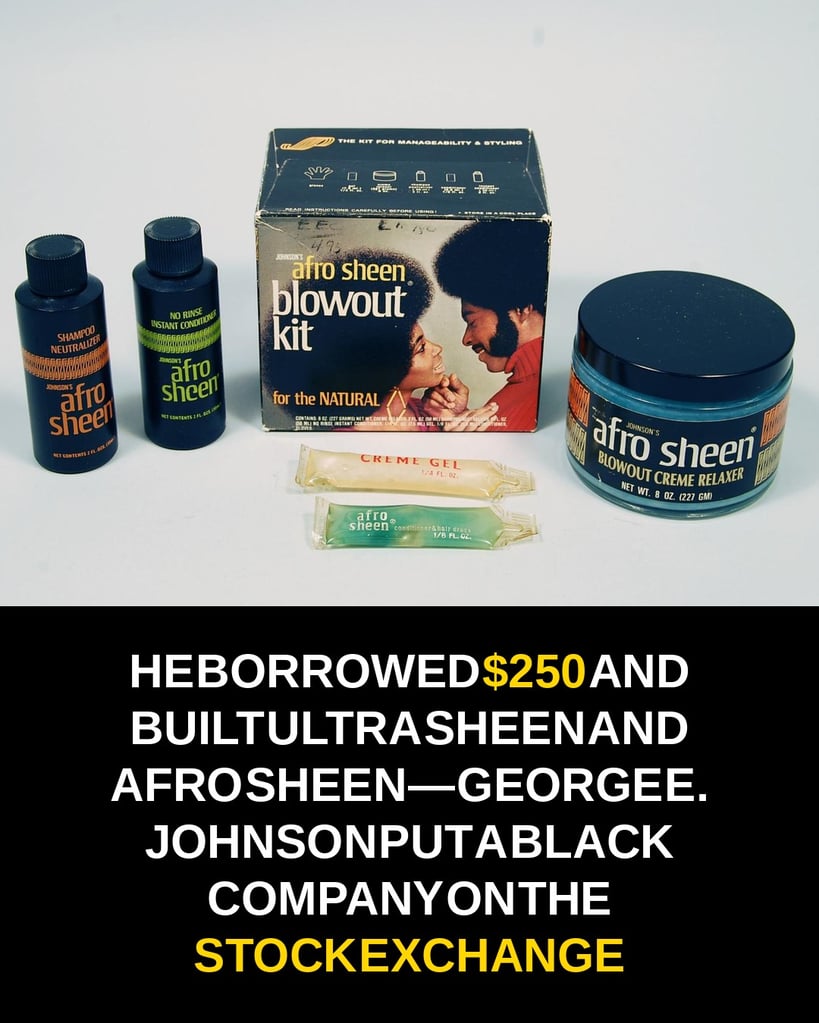
We lost him this year — and every shelf in America still carries his blueprint. George E. Johnson, who started a company on a $250 loan and built it into Ultra Sheen and Afro Sheen, died on July 6, 2026, in Chicago, at 99. Before there was an aisle, before there was an industry, there was a production chemist and his wife deciding to build their own.
Johnson worked as a production chemist for S.B. Fuller before he struck out on his own. In 1954, in Chicago, he co-founded Johnson Products with his wife Joan — on a $250 loan. Sit with that number. Two hundred and fifty dollars, a chemist’s knowledge, and a family willing to bet on itself. That was the whole starting capital for what became one of the most important Black-owned companies in American history.
Ultra Sheen followed in 1957. By 1966, the company controlled nearly half the professional relaxer market, on roughly $5 million in annual sales. Then, in the late 1960s, came Afro Sheen — and Afro Sheen was more than a product. It became a cultural fixture, a name spoken in barbershops, bathrooms and family kitchens across the country, at exactly the moment Black America was wearing its hair — and its pride — out loud.
The first name on the exchange
In 1971, Johnson Products became the first Black-owned company listed on the American Stock Exchange. Read that plainly: a company founded on a $250 loan in Chicago walked onto the American Stock Exchange, in a place where no Black-owned company had ever stood before. And it did not arrive small. Sales climbed from $10.2 million in 1971 to $75 million in 1975 — a rise that told Wall Street, in the only language it fully respects, exactly what this market and this founder were worth.
Johnson Products was also the first Black-owned company to sponsor a nationally syndicated TV program — Soul Train. Think about what that pairing meant: the products in the home, and the music and the movement on the screen, carried by the same Black-owned company. He was not just selling hair care. He was underwriting Black culture, in prime view, with his company’s name on it.
The later chapters were harder. He lost control of the company after a divorce settlement, and it was sold to IVAX in 1993. But losing the company never erased who built it — and near the end of his life, he told the story himself, publishing his memoir, Afro Sheen, in 2025, at an age when most founders’ stories are told only by other people.
So this is a farewell, family. A chemist. A wife beside him at the founding. A $250 loan. Nearly half a professional market. A first on the American Stock Exchange. $75 million in sales by 1975. And a sponsor’s name under Soul Train. George E. Johnson proved the blueprint works — ownership, built at home, scaled to the nation. Rest well, sir. The shelves remember.
Join the conversation
What Johnson Products memory lives in YOUR family — the Ultra Sheen, the Afro Sheen, the Soul Train Saturdays? And be honest: did you know a $250 loan was where it all started? Tell us below, and share a farewell for Mr. Johnson.
Source note: George E. Johnson (1927–2026) worked as a production chemist for S.B. Fuller before co-founding Johnson Products in Chicago in 1954 with his wife Joan, on a $250 loan; Ultra Sheen followed in 1957, by 1966 the company controlled nearly half the professional relaxer market on roughly $5 million in annual sales, Afro Sheen arrived in the late 1960s and became a cultural fixture, in 1971 Johnson Products became the first Black-owned company listed on the American Stock Exchange with sales climbing from $10.2 million in 1971 to $75 million in 1975, Johnson Products was also the first Black-owned company to sponsor a nationally syndicated TV program, Soul Train, he lost control of the company after a divorce settlement and it was sold to IVAX in 1993, he published his memoir, Afro Sheen, in 2025, and he died on July 6, 2026, in Chicago, at 99 — from Black Enterprise and Inc. obituaries (July 2026) and Ebony.