
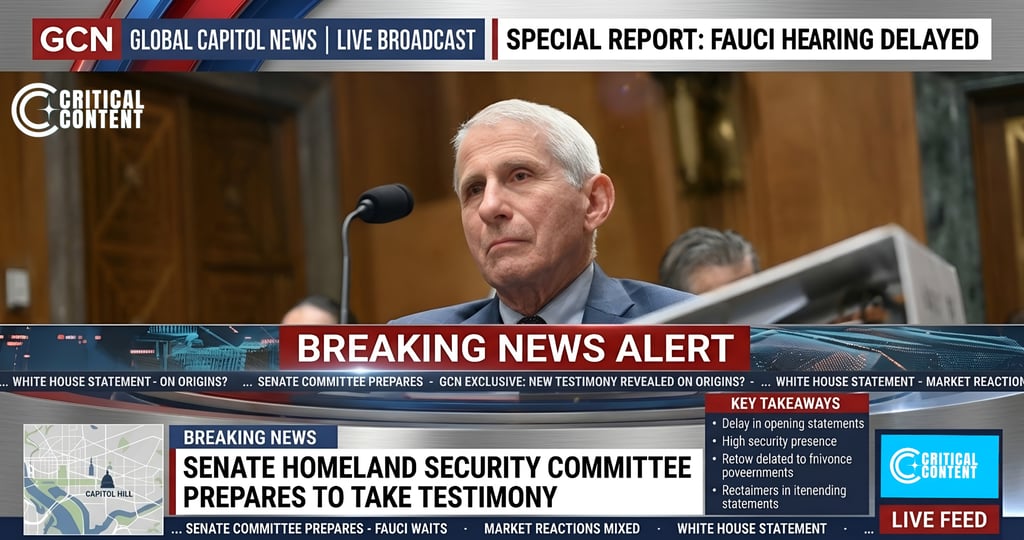
Dr. Anthony Fauci, the former longtime director of the National Institute of Allergy and Infectious Diseases (NIAID) and one of the leading public health figures during the COVID-19 pandemic, invoked his Fifth Amendment right during a U.S. Senate hearing on Wednesday.
Appearing before the Senate Homeland Security and Governmental Affairs Committee under a subpoena issued by Committee Chairman Sen. Rand Paul (R-Ky.), Fauci declined to answer questions, saying he was acting on the advice of his attorneys.
The hearing comes after years of political and scientific debate surrounding the origins of COVID-19, including competing theories about whether the virus emerged naturally or resulted from a laboratory-related incident.
What Happened
At the start of the hearing, Fauci made a brief statement explaining why he would not respond to lawmakers’ questions.
“Although it pains me to do so, because of the respect I have for the legislative branch of government, and my decades-long record of cooperating with Congress, under the advice of my attorneys, I will invoke my right under the Fifth Amendment of the Constitution to refrain from answering your questions.”
The Fifth Amendment to the U.S. Constitution protects individuals from being compelled to provide testimony that could potentially incriminate themselves.
Fauci’s appearance followed a subpoena issued by Sen. Rand Paul, who has frequently questioned Fauci regarding the federal government’s handling of the pandemic and the origins of SARS-CoV-2, the virus that causes COVID-19.
The hearing focused heavily on allegations raised by Paul concerning Fauci’s internal notes and communications during the early months of the pandemic.
Background
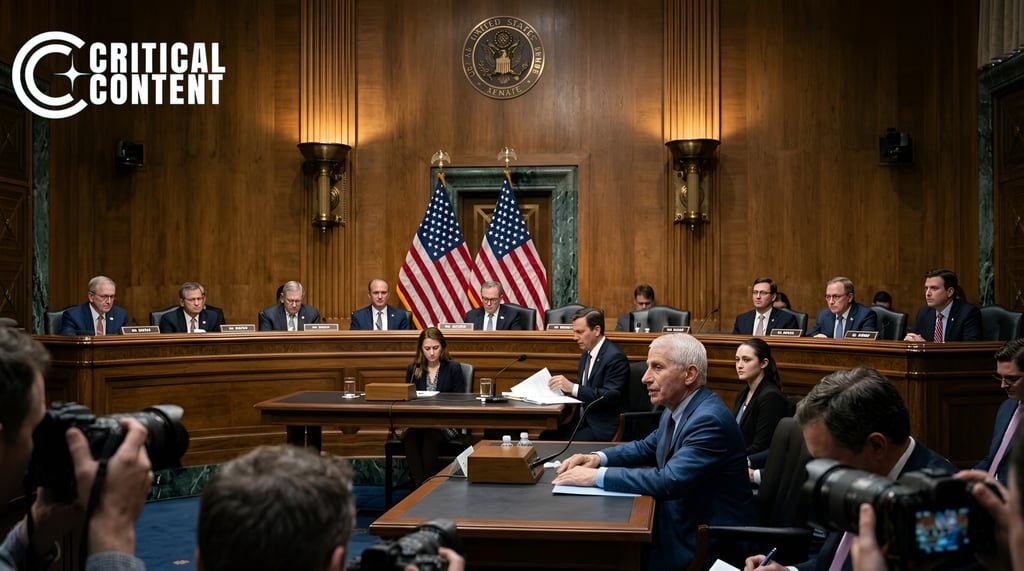
The origins of COVID-19 have remained one of the most debated issues since the pandemic began.
Two primary theories continue to receive attention:
- Natural (zoonotic) spillover, where the virus passed from animals to humans.
- Laboratory-related origin, suggesting the virus may have accidentally escaped from a research facility.
According to the World Health Organization’s Scientific Advisory Group for the Origins of Novel Pathogens, the weight of currently available scientific evidence continues to favor a natural spillover event, while acknowledging that additional evidence is needed and that investigations remain incomplete.
Within the U.S. government, agencies have reached different assessments. Some agencies lean toward a natural origin, while others—including the FBI and the Department of Energy—have expressed varying levels of support for a possible laboratory-related origin. The Department of Energy has stated that its assessment carries low confidence, meaning the available evidence is limited and uncertain.
Why This Matters
Fauci’s decision to invoke the Fifth Amendment has quickly become a major political story because of his prominent role during the pandemic.
However, legal experts often note that invoking the Fifth Amendment is a constitutional right and should not, by itself, be interpreted as evidence of guilt or wrongdoing.
The hearing also reflects the continuing political disagreements surrounding:
- The origins of COVID-19.
- Government transparency.
- Scientific decision-making during public health emergencies.
- Congressional oversight.
The issue remains highly divisive, even more than six years after the pandemic began.
Public Reaction
The hearing generated widespread discussion across political leaders, scientists, legal analysts, and social media.
Supporters of Sen. Rand Paul argued that continued congressional oversight is necessary to better understand decisions made during the pandemic.
Others defended Fauci’s decision to invoke his constitutional rights, emphasizing that individuals appearing before congressional committees are entitled to legal protections.
Meanwhile, many scientists cautioned against interpreting early scientific discussions as evidence of misconduct, noting that evolving hypotheses are a normal part of scientific research when investigating a newly emerging virus.
Expert or Wider Context
Several researchers interviewed by NPR said Fauci’s early consideration of multiple origin theories reflected standard scientific practice rather than wrongdoing.
Virologist Felicia Goodrum of Dartmouth College said that scientists naturally explored numerous possibilities during the early stages of the outbreak when little was known about the virus.
Similarly, biosecurity expert Gigi Gronvall noted that evaluating competing hypotheses is a routine part of scientific investigation and does not imply that any single theory has been proven.
The World Health Organization has also stated that all scientifically plausible hypotheses should continue to be examined as additional evidence becomes available.
Final Thoughts
Anthony Fauci’s appearance before the Senate committee marks another chapter in the ongoing debate surrounding the COVID-19 pandemic and its origins.
While his decision to invoke the Fifth Amendment has drawn significant political attention, it does not resolve the broader scientific questions that continue to be studied by researchers around the world.
As investigations and historical reviews continue, experts stress the importance of distinguishing between political debate, legal proceedings, and scientific evidence. The origins of COVID-19 remain an area of active discussion, with no universally accepted definitive conclusion.
FAQ