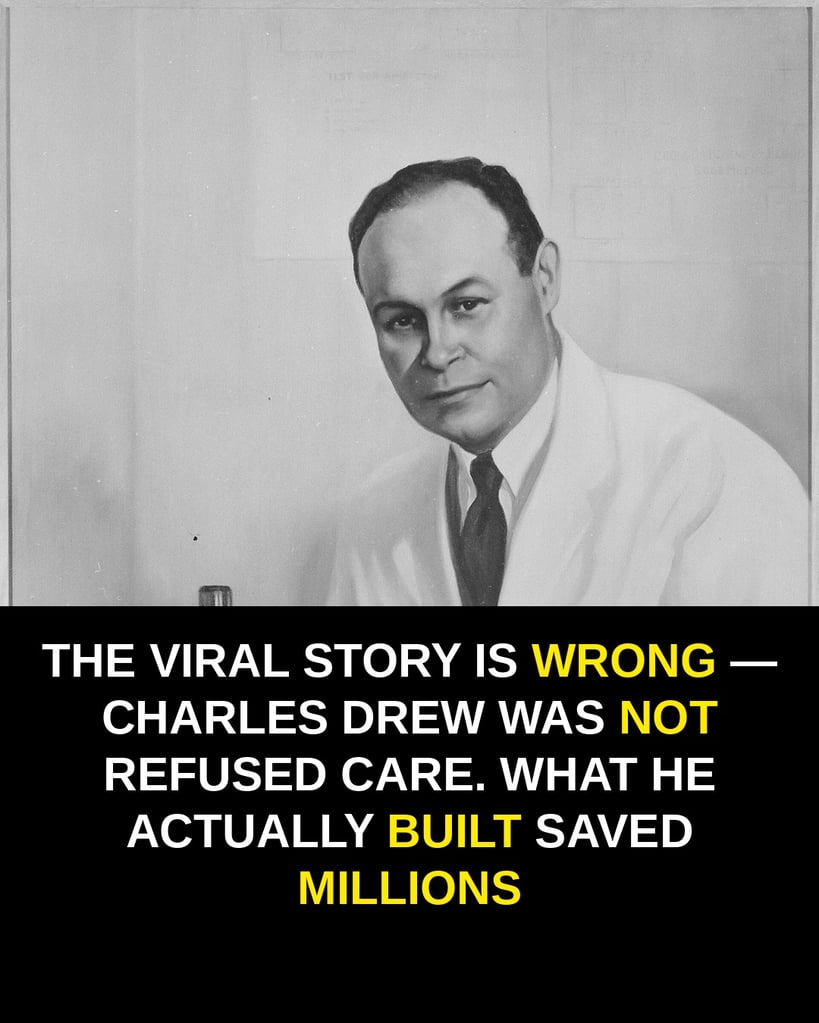
You have probably seen the viral version of this story: the man who built the blood bank system bled to death because a hospital refused to give him a transfusion. It is a powerful story. It is also not true — and Charles Drew’s family, his biographer, and the doctors who treated him have said so for decades. This page corrects the record, because the man deserves his real legacy.
First, the part that is true, because it is extraordinary enough on its own. Dr. Charles R. Drew was a physician and surgeon who built modern blood banking. In 1940 he invented a method for banking and processing plasma — the breakthrough that made large-scale blood storage and shipment practical. In 1941 he became founding director of the American Red Cross blood bank. The systems he built have saved millions of lives. That is documented, and it needs no decoration.
Now the myth, and the evidence against it.
The myth: “he was refused treatment and bled to death”
The viral claim says that after a 1950 car crash, Drew was turned away or denied a transfusion by a whites-only hospital and died as a result — the inventor of the blood bank, killed by the very system segregation built.
It is an understandable story to believe. Segregation was real, and Black patients were denied care in that era, systematically. But in Drew’s specific case, the documented record says something different — and the people closest to the case have been correcting it for years.
What the record actually shows
On April 1, 1950, Drew was in a car crash in North Carolina. Per his biographer, Dr. Spencie Love (One Blood), fellow surgeons who rode with him testified that he was taken to Alamance General Hospital — and that he received treatment, including a transfusion. His injuries were described as so severe they were unsurvivable. He died of those injuries, not of a refusal.
His own family has said the same, repeatedly: the refusal story is not true.

The myth’s origin is traceable, too. Per Logan (1995), a playwright admitted he invented the refusal detail to heighten the film version of Drew’s life. An admitted invention, in a dramatization, escaped into the culture and eventually outran the documented truth — amplified, decades later, by viral posts that never checked.
Why this page corrects one of its own favorite stories
Because the true story is better, and because accuracy is the tribute.
A false legend makes Drew’s legacy rest on an irony that never happened. The real legacy needs no irony: a Black physician, working in a segregated country, built the blood-banking systems the whole world now uses — plasma processing that made saving lives at scale possible, and a national blood bank he directed from its founding. Millions of living people owe their survival to infrastructure Charles Drew designed. That is not a lesser story than the myth. It is a greater one, and it has the additional virtue of being true.
There is also a matter of respect for the record itself. Drew’s family asked for the truth to be told. His biographer documented it. The surgeons who were there testified to it. A page that celebrates Black excellence does not need to borrow a tragedy that the man’s own family says did not happen to him.
Tell the real one. He built the system that saves lives by the millions. That was Charles Drew.
Join the conversation
Be honest: had YOU shared the viral version before today? And does the true story — the inventor, the system, the millions saved — land harder for you than the myth did? Tell us below.
Source note: Charles Drew’s documented record — his 1940 method for banking and processing plasma, his 1941 role as founding director of the American Red Cross blood bank, and the millions of lives the systems he built have saved — is established history. The correction of the refusal myth rests on: his biographer Dr. Spencie Love (One Blood) and the testimony of fellow surgeons who rode with him after the April 1, 1950 North Carolina crash, that he was taken to Alamance General Hospital and did receive treatment including a transfusion, his injuries being unsurvivable; statements by Drew’s family that the refusal story is not true; and Logan (1995) on a playwright admitting he invented the refusal detail for a dramatized film version. This article follows that documented record.
Tell us in the comments below - we read every single one, and the best takes get featured.