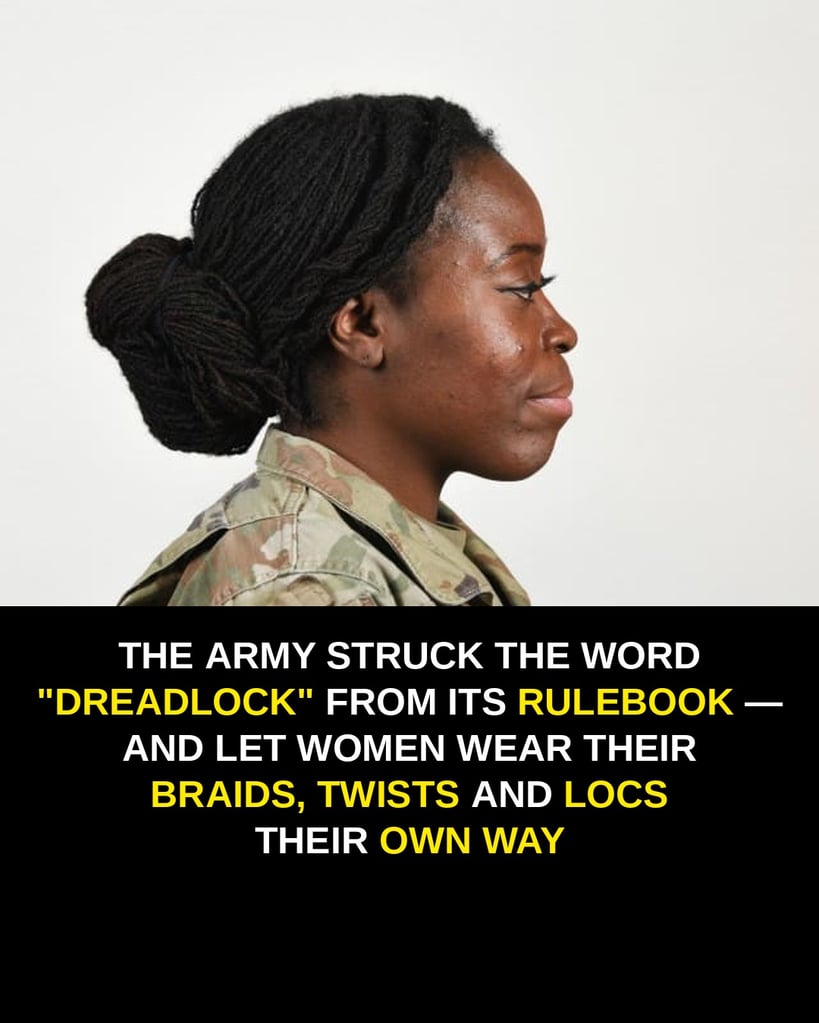
For decades, some of the strictest hair rules in America weren’t in a school handbook. They were in an Army regulation. In 2021, the Army rewrote that regulation — and struck the word “dreadlock” clean out of it.
The changes were announced on January 26, 2021, and took effect February 24–25, 2021, through a revision of AR 670-1, the Army’s grooming and appearance regulation, issued as ALARACT 015/2021. This was no rumor and no trial balloon: it was the rulebook itself, changed in writing, for the largest branch of the U.S. military.
And the people who shaped the rewrite were soldiers. The changes came after a review panel of 17 soldiers — mostly women — went through the standards that governed how they were allowed to wear their own hair.
What actually changed
Start with the headline items, because there are several, and each one undid years of friction.
There is no more minimum hair length for women. Soldiers may wear multiple hairstyles at once — braiding, twists or locs combined in a single style, instead of being forced into one approved category. And the old rules requiring braids, cornrows, twists and locs to be uniform in size and spacing were scrapped — the regulation stopped dictating that every braid and every loc march in identical formation.
Ponytails were authorized for soldiers who cannot form a bun — including long ponytails in physical training and in tactical gear, the settings where a bun requirement had been most impractical. Women could also wear earrings in the combat uniform, a small change that signalled the same larger shift: the standard was being rewritten around the soldiers actually wearing the uniform.
The words they took out
Then there is the language — and for a natural hair page, this might be the most telling part of the whole revision.

The regulation removed the words “dreadlock,” “faddish,” “eccentric,” “Fu Manchu” and “Mohawk” from its descriptions.
Words in a rulebook are never just words. When a regulation reaches for “faddish” and “eccentric” to describe styles, it is building a judgment into the rule before the rule is even applied — and styles like locs had lived under that judgment, named in the text itself. Deleting the word “dreadlock” from the regulation did not just tidy up the vocabulary. It removed the label that had hung over one of the oldest hairstyles in the world inside one of the most rule-bound institutions on earth.
Why this one travels
A school can write its own handbook. A company can hide behind “professional appearance.” But when the United States Army — an institution that literally regulates the length of a mustache — sits down with a panel of its own soldiers, listens to the women, and rewrites the book so braids, twists and locs can be worn their own way, the old excuse gets harder to use everywhere else.
If locs can meet Army standards, in tactical gear, on duty — what exactly is the argument left in a classroom or an office?
The standard moved because the soldiers inside the institution pushed it, on the record, through the proper channel, and got the words changed in writing. That is what a policy win looks like: dated, numbered, and effective.
Join the conversation
Should every school and employer in America have to meet the standard the Army set in 2021 — and were YOU ever told your braids, twists or locs weren’t “uniform” enough for a job? Tell us below.
Source note: The 2021 Army grooming changes — announcement on January 26, 2021, effective February 24–25, 2021, revising AR 670-1 via ALARACT 015/2021, following a review panel of 17 soldiers, mostly women — are from the U.S. Army release carried by DVIDS (February 1, 2021) and the ALARACT 015/2021 text. The specific provisions — no minimum hair length for women, multiple hairstyles worn at once, the scrapping of uniform size-and-spacing rules for braids, cornrows, twists and locs, ponytails for soldiers who cannot form a bun including in physical training and tactical gear, earrings in the combat uniform, and the removal of the words “dreadlock,” “faddish,” “eccentric,” “Fu Manchu” and “Mohawk” — are as set out in that release and regulation text, with a summary by FedWeek.
Tell us in the comments below - we read every single one, and the best takes get featured.