
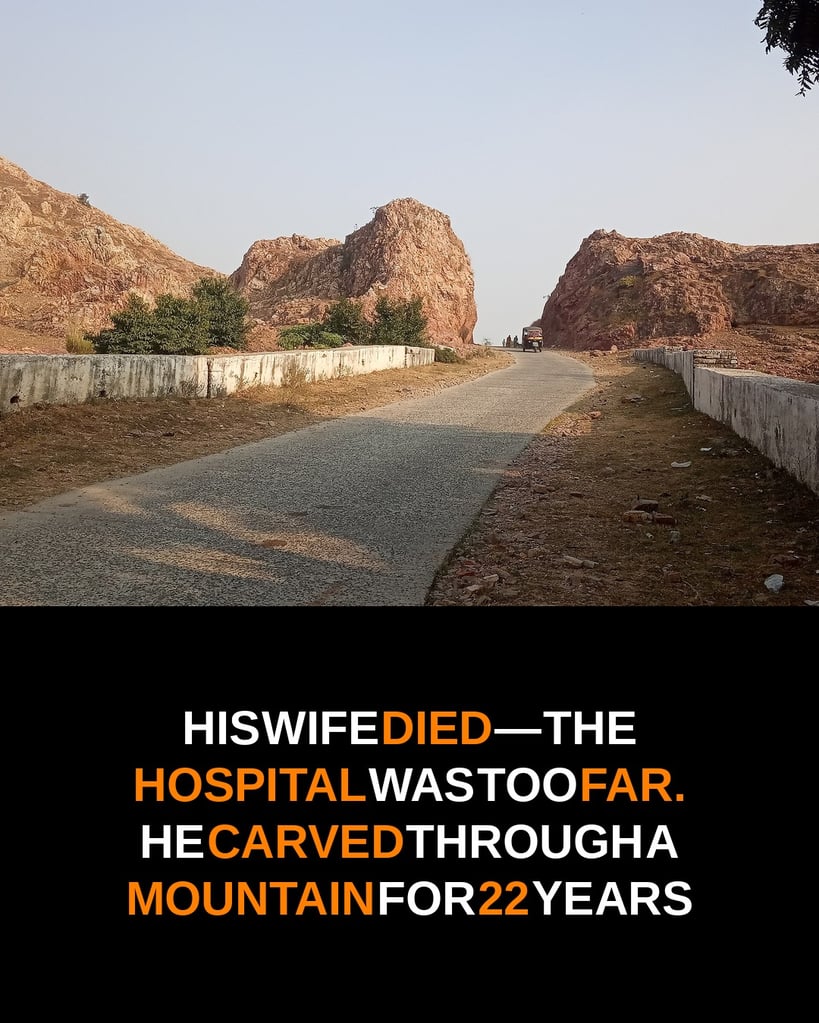
The mountain was between his village and the doctor, and in 1959 it killed his wife. Falguni Devi fell crossing the rocky ridge above Gehlaur village in Bihar, India, and the nearest medical help was some 70 kilometers away by the only route around. She died without timely care. So Dashrath Manjhi picked up a hammer and a chisel, and for 22 years, he attacked the mountain.
Understand the scale of the grudge. Manjhi was a laborer — a farmhand by day, working other men’s fields for wages. In 1960, in his spare hours, he started chiseling a road through the ridge itself. His neighbors called him mad. A poor man, with hand tools, against a mountain: the village’s verdict was that grief had broken him.
He kept chiseling. Day work for survival, mountain work for Falguni — year after year, through the 1960s, the 1970s, into the 1980s, one man’s arms doing the labor of a road crew and its machinery. When he finished in 1982, the path he had carved ran 110 metres long, 9.1 metres wide and up to 7.7 metres deep — a road cut through solid rock by one pair of hands.
What 22 years bought his neighbors
The journey between the Atri and Wazirganj blocks — the trip to the doctor, to the market, to help — fell from 55 kilometers to 15 kilometers. That’s the documented count, and this page prints it exactly, because Manjhi’s real numbers are staggering enough without the inflated versions that travel with his name. (Two viral decorations are deliberately left off: the “Padma Shri” award claim — his name was proposed in 2006, but no award is confirmed by reliable sources — and the “70 km to 1 km” variant, which the documented record doesn’t support.)
Manjhi died on August 17, 2007, and the state that had ignored his mountain for two decades gave him a state funeral. A paved road and a hospital in his name followed, and his story became the 2015 film Manjhi – The Mountain Man. The man the village called mad is now the name on the hospital at the end of the road he cut — the road that exists so that no other husband in Gehlaur has to learn what 70 kilometers means.
Plenty of monuments are built by governments after the fact. This one was built by the widower, in advance, one chisel strike at a time, for 22 years — so that strangers he’d never meet would have a shorter road to help than his wife did.
Join the conversation
Twenty-two years. A hammer, a chisel, and a mountain that took his wife. Could you keep swinging for 22 years at a problem everyone else called madness — and what is the mountain standing between YOUR community and help? Tell us below.
Source note: Dashrath Manjhi’s account — a laborer in Gehlaur village, Bihar, whose wife Falguni Devi died in 1959 after falling while crossing the rocky ridge above the village, with the nearest doctor some 70 km away by the only route; his beginning in 1960 to carve a road through the ridge with a hammer and chisel, working as a farmhand by day while neighbors called him mad; the finished path after 22 years (1960–1982) measuring 110 metres long, 9.1 metres wide and up to 7.7 metres deep, cutting the journey between the Atri and Wazirganj blocks from 55 km to 15 km; his death on August 17, 2007 and state funeral, followed by a paved road and a hospital in his name and the 2015 film Manjhi – The Mountain Man — is from his sourced biography cross-checked against multiple Indian news retrospectives. The “Padma Shri” claim (his name was proposed in 2006; no award is confirmed) and the “70 km to 1 km” variant are not printed, as reliable sources do not support them.

