
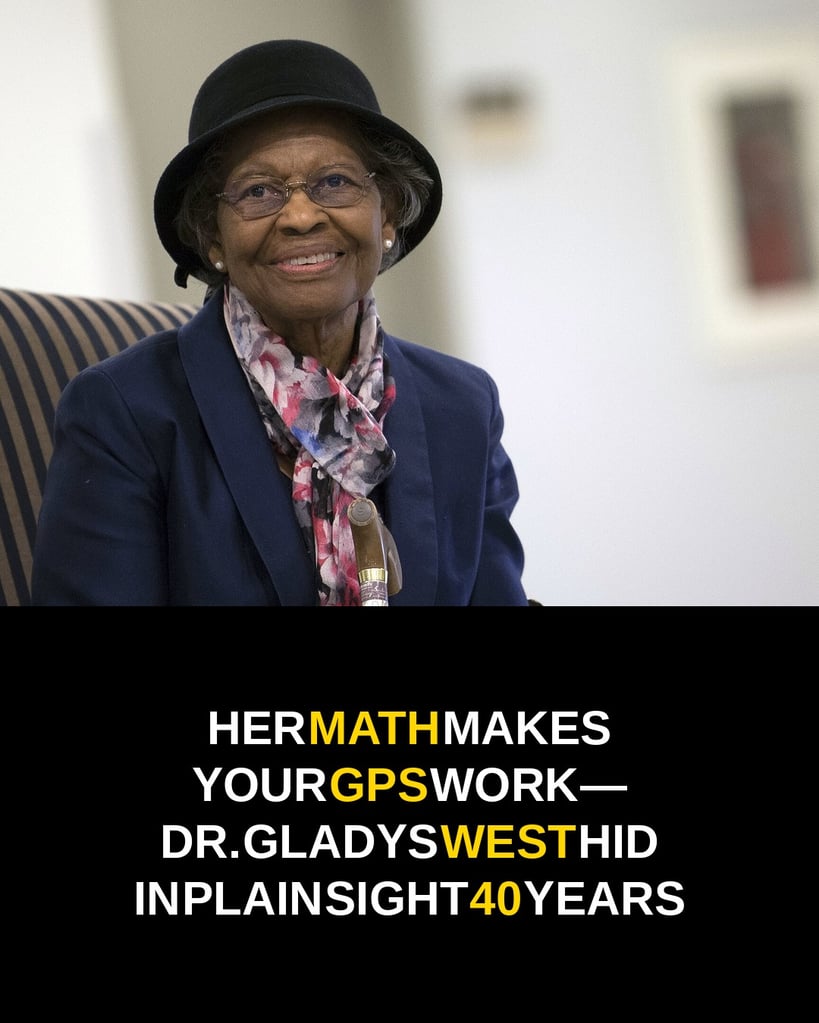
The world lost Dr. Gladys West this year — on January 17, 2026, at 95 — and most of the world never knew it had her. For 42 years she worked in near-total obscurity on the mathematics your phone uses every single day to know where on Earth it is. Her math helped make GPS possible. Say it exactly that way — her own record asks for nothing more, and needs nothing more.
West was hired in 1956 at the Naval Proving Ground in Dahlgren, Virginia — only the second Black woman hired there, and one of just four Black employees on the whole base. She stayed for 42 years, retiring in 1998. In a place that employed thousands and celebrated few, a Black woman from Virginia did the patient, exacting work that the modern world quietly stands on.
Her assignments were the kind that don’t make speeches. She served as project manager of Seasat, launched in 1978 — the first satellite designed to sense the oceans. And she did the satellite-geodesy work at the heart of her legacy: processing GEOSAT altimeter data into an increasingly precise mathematical model of the Earth’s shape — the geoid — the model that GPS calculations rely on to turn satellite signals into a location on the ground.
That is the accurate frame, and this page keeps it: she did not single-handedly “invent GPS,” and her story is not printed that way. What she built was foundational — the mathematical Earth that the whole system measures against. Foundations don’t get the billboard. They get everything built on top of them.
Forty years hidden, then the honors came
Almost nobody knew. For decades, the woman whose geoid model sat inside the world’s navigation told her story to almost no one — until she mentioned the work in a short biography written for an Alpha Kappa Alpha alumni event, and the sorority sisters who read it understood exactly what they were holding.
The honors, forty years late, arrived in a rush. On December 6, 2018, West was inducted into the Air Force Space and Missile Pioneers Hall of Fame. Then came a Webby Lifetime Achievement Award, the Prince Philip Medal in 2021, and the IEEE President’s Award in 2024. Institutions lined up in her nineties to say what her own workplace had let sit in silence since the 1970s: the math was hers.
She was 95 when she died this January, honored at last and still, somehow, less famous than the blue dot she helped put in every pocket on Earth. Every map that has ever found you, every ride that ever reached you, every lost driver her model ever guided home — that is her monument, and it refreshes every few seconds, all over the world, whether anyone says her name or not. Say it anyway. Gladys West.
Join the conversation
Did you know Dr. Gladys West’s name before this year — and be honest, how many times TODAY has your phone already used her math? Share this so the woman behind the blue dot gets her flowers in every feed. Tell us below.
Source note: Dr. Gladys West’s account — hired in 1956 at the Naval Proving Ground in Dahlgren, Virginia, as only the second Black woman hired there and one of just four Black employees; her 42-year career ending with retirement in 1998; her work as project manager of Seasat (1978, the first satellite designed to sense the oceans) and her satellite-geodesy work processing GEOSAT altimeter data into a precise mathematical model of the Earth’s shape (the geoid) that GPS calculations rely on — framed here as “her math helped make GPS possible,” never “she invented GPS”; the work remaining little known until she mentioned it in a short biography for an Alpha Kappa Alpha alumni event; her induction into the Air Force Space and Missile Pioneers Hall of Fame on December 6, 2018, followed by a Webby Lifetime Achievement Award, the Prince Philip Medal (2021) and the IEEE President’s Award (2024); and her death on January 17, 2026, at 95 — is from Encyclopaedia Britannica and IEEE Spectrum.

