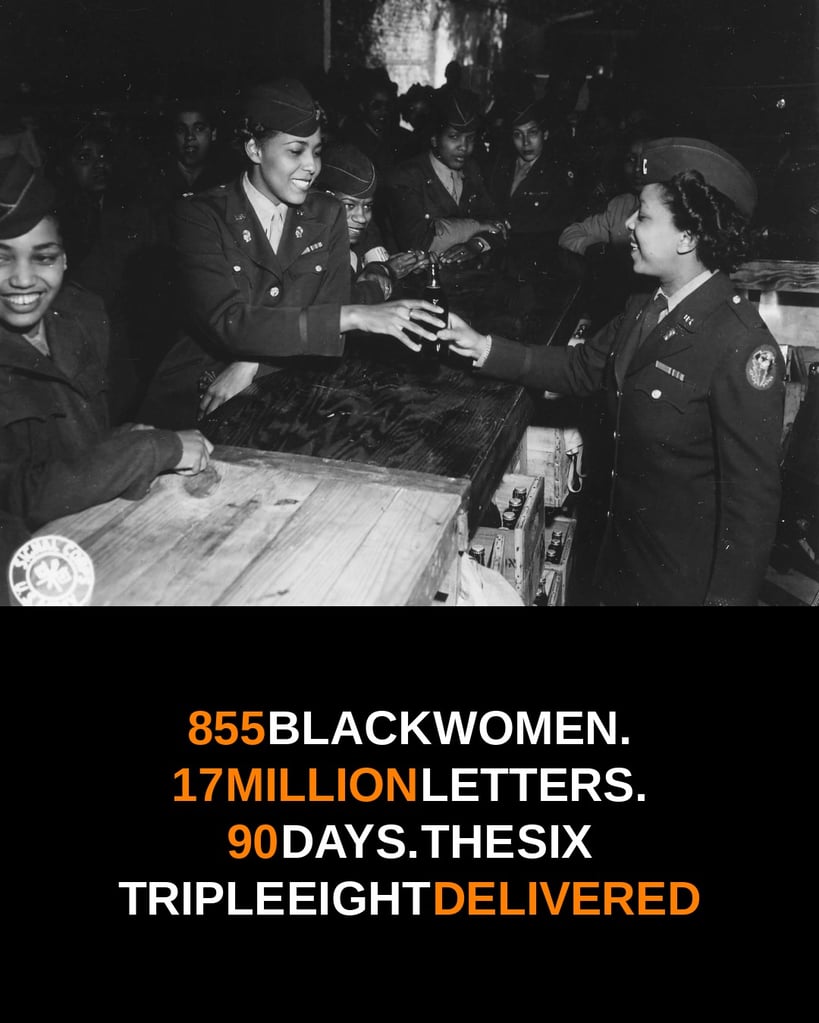
Picture the warehouses: unheated, dimly lit, stacked to the ceiling with sacks of undelivered mail — letters from mothers, wives and sweethearts to soldiers who had been waiting months, sometimes years, to hear from home. Some 17 million pieces of it. The Army said the backlog would take six months to clear. The 855 Black women of the 6888th did it in about 90 days.
The 6888th Central Postal Directory Battalion sailed to England in February 1945 — the only all-Black Women’s Army Corps unit sent overseas in World War II — under the command of Major Charity Adams. Their assignment was the mail: mountains of it, piled in Birmingham warehouses, undelivered because the war kept moving the men it was addressed to. Every sack represented a soldier in a foxhole wondering if home had forgotten him, and a family at a kitchen table wondering the same in reverse.
So the women of the Six Triple Eight built a system and ran it like the war depended on it — because for morale, it did. They worked three shifts around the clock, seven days a week, processing some 65,000 pieces of mail per shift, tracking down soldiers through serial numbers, nicknames and half-legible addresses. Their motto said everything: “No mail, low morale.”
Ninety days, then they did it again
Army leadership had projected six months for the Birmingham backlog. The 6888th cleared some 17 million pieces in about 90 days — half the time — and then shipped to Rouen, France, and did it again. Six months of work in three, twice, by a unit the Army had segregated, under-equipped and never expected to be the story.
They came home to little recognition. The medals arrived by decades instead of years: a monument at Fort Leavenworth in 2018, a Meritorious Unit Commendation in 2019, the Congressional Gold Medal Act signed on March 14, 2022 — and in 2024, Tyler Perry’s Netflix film, The Six Triple Eight, carried their name to the audience it always deserved.

Eight hundred and fifty-five women, most of them grandmothers and great-grandmothers by the time the honors caught up. They didn’t carry rifles. They carried the mail — 17 million pieces of it — and understood before their commanders did that a letter is not paper. To a soldier in 1945, it was the whole reason, arriving in an envelope.
The details of their working life deserve one more beat, because they explain the speed. These were not clerks fed a tidy stack of sorted envelopes. The mail arrived in mountains, addressed to men who had moved, been wounded, or died; the women worked from partial names, nicknames and serial numbers, cross-referencing records to find a single soldier in a theater of millions — some 65,000 pieces per shift, in cold, dim warehouses, three shifts a day, seven days a week. Clearance at that rate wasn’t effort alone; it was system design by the people doing the work. The Army projected six months because it imagined its own methods. The 6888th imagined better ones, in Birmingham, in the cold, and beat the projection in half.
Join the conversation
Seventeen million letters. Ninety days. Three shifts a day, seven days a week. Did YOU know the Six Triple Eight’s story before the film — and whose grandmother in your family carried a war effort nobody thanked her for? Tell us below.
Source note: The Six Triple Eight account — the 6888th Central Postal Directory Battalion of 855 women, the only all-Black Women’s Army Corps unit sent overseas in WWII, sailing to England in February 1945 under Maj. Charity Adams; the unheated, dimly lit Birmingham warehouses of undelivered mail; the three-shifts-around-the-clock, seven-days-a-week operation processing some 65,000 pieces per shift; the Army’s six-month projection against the women’s clearing of a backlog of some 17 million pieces of mail in about 90 days, repeated in Rouen, France; the unit motto “No mail, low morale”; and the later honors — the Fort Leavenworth monument (2018), Meritorious Unit Commendation (2019), Congressional Gold Medal Act signed March 14, 2022, and Tyler Perry’s 2024 Netflix film The Six Triple Eight — is from Smithsonian Magazine, the U.S. Army Center of Military History, and the National WWII Museum.
Tell us in the comments below - we read every single one, and the best takes get featured.