
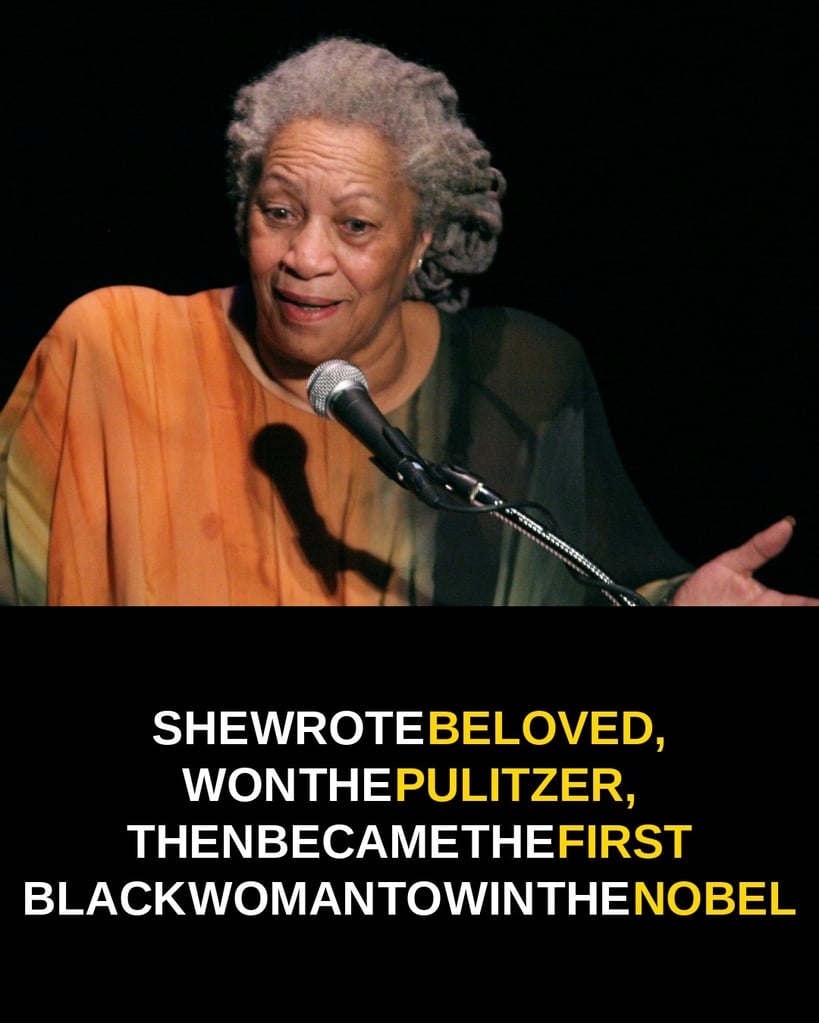
She spent years putting other writers’ books into the world before the world ever saw one of hers. Then Toni Morrison published her first novel at 39, wrote Beloved, won the Pulitzer Prize — and in 1993 became the first Black woman in history to win the Nobel Prize in Literature. This is a tribute to the editor who became the standard.
Toni Morrison was born Chloe Ardelia Wofford on February 18, 1931, in Lorain, Ohio. Through the 1960s she worked as a textbook and fiction editor — and in the late 1960s she became the first Black woman senior editor in fiction at Random House, where she championed Black writers and shepherded their work into print. Think about what that means: before she was an author the world celebrated, she was the person in the room insisting that Black voices belonged on the list. She opened the door from the inside, holding it for others, while her own first novel was still unwritten.
She published that first novel, The Bluest Eye, at 39. It was the start of a body of work — 11 novels in all — that would redraw what American literature was allowed to be about, and whose stories it was allowed to tell from the inside.
Beloved, the Pulitzer, and the Nobel
Her fifth novel, Beloved (1987), was inspired by the true story of Margaret Garner, an enslaved woman who escaped across the Ohio River. It is a haunted, towering book — a ghost story that is also the truest kind of history — and in 1988 it won the Pulitzer Prize for Fiction.
Then, in 1993, came the honor no Black woman had ever received: the Nobel Prize in Literature. The Swedish Academy honored her for novels “characterised by visionary force and poetic import.” First Black woman. Ever. In the prize’s entire history. President Obama later awarded her the Presidential Medal of Freedom in 2012 — a president who had read her, honoring the writer who had helped teach a country how to read itself.
Morrison died on August 5, 2019, in New York, at 88. She left 11 novels, a generation of writers she edited into existence before her own fame, and a standard that still stands at the top of the form: visionary force, poetic import, and stories of Black life told with the full gravity they had always deserved and so rarely received. She was an editor first. She knew exactly what the shelf was missing — because she had spent years stocking it. Then she wrote the missing books herself.
Join the conversation
Which Toni Morrison book reached you first — Beloved, The Bluest Eye, or another one — and be honest, did a teacher put it in your hands or did you find her on your own? And should every American student read Beloved before they graduate? Tell us below.
Source note: Toni Morrison’s story — born Chloe Ardelia Wofford on Feb 18, 1931, in Lorain, Ohio; spending the 1960s as a textbook and fiction editor and becoming, in the late 1960s, the first Black woman senior editor in fiction at Random House, where she championed Black writers; publishing her first novel, The Bluest Eye, at 39; her fifth novel, Beloved (1987), inspired by the true story of Margaret Garner, an enslaved woman who escaped across the Ohio River, winning the Pulitzer Prize for Fiction in 1988; becoming in 1993 the first Black woman to win the Nobel Prize in Literature, honored by the Swedish Academy for novels “characterised by visionary force and poetic import”; receiving the Presidential Medal of Freedom from President Obama in 2012; writing 11 novels in all; and dying Aug 5, 2019, in New York, at 88 — is from Princeton University (obituary), Nobel Prize records, and Gale Biography. Written in past tense as a tribute.