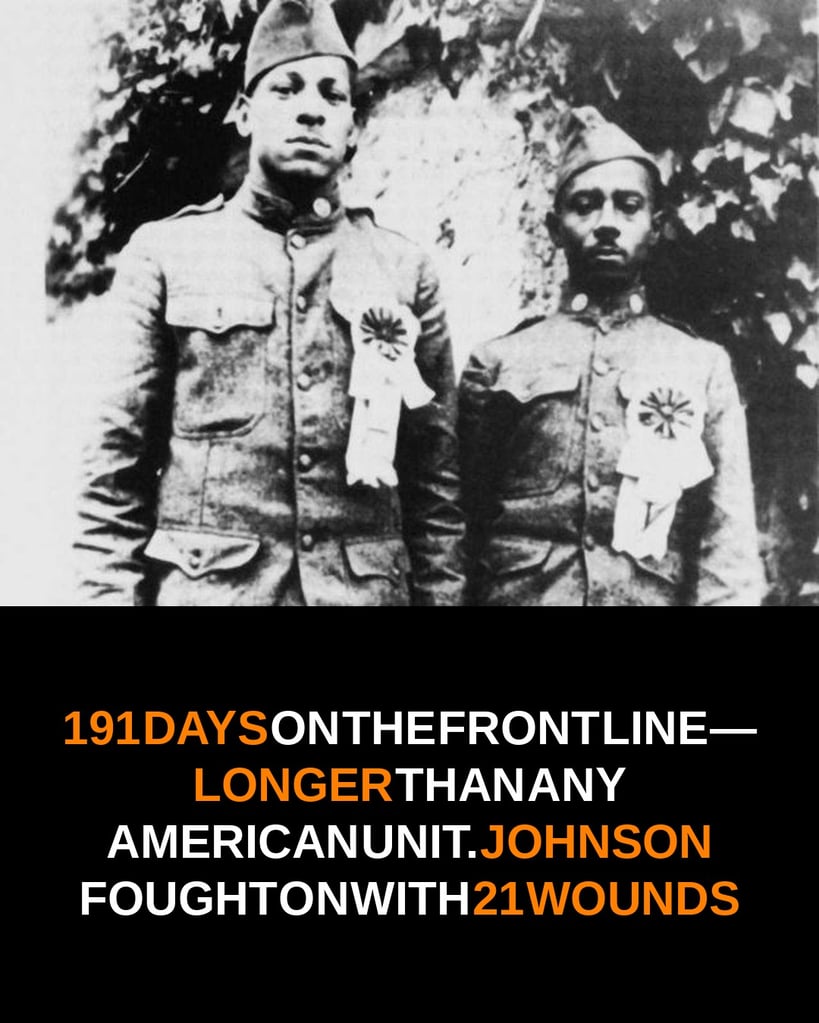
Their own army wouldn’t fight beside them — so France took them, and they stayed on the front line for 191 days, longer than any other American unit of their size. The Germans gave them their name in respect and fear: the Harlem Hellfighters.
The 369th Infantry Regiment was an all-Black New York National Guard unit. In 1918, the segregated U.S. Army handed them to the French Army, because it would not fight them alongside white American troops. Sit with that for a second: American soldiers, in an American war, assigned to a foreign army because of the color line at home. Under French command, the Hellfighters went into the trenches — and stayed. One hundred ninety-one days of front-line combat, more continuous combat than any other American unit of their size endured in the war. They suffered more than 1,400 casualties holding those lines. France, at least, said thank you properly: the Croix de Guerre was awarded to 171 members of the regiment, along with a unit citation.
The night Henry Johnson became a legend
The regiment’s legend was made before dawn on May 15, 1918, in the Argonne. Privates Henry Johnson and Needham Roberts were on sentry duty when a German raiding party hit their post. Roberts was knocked out by a grenade. Johnson — 5-foot-4, 130 pounds — fought on alone: grenades first, then his rifle until it jammed, and finally a bolo knife, hand to hand in the dark. He killed four Germans and refused to let them drag Roberts away — despite suffering 21 wounds in the fight.
France gave Johnson the Croix de Guerre with Gold Palm — he was the first American so honored in the war. His own country, the one that had handed his whole regiment to another army, took a little longer. A little longer turned out to be nearly a century: Johnson received the Medal of Honor only in 2015, posthumously. And the regiment as a whole received the Congressional Gold Medal in 2025 — 107 years after the 191 days.
What 191 days should have bought
The Hellfighters’ story is two stories at once, and this page won’t soften either one. The first is a combat record any army on Earth would claim with pride: the longest front-line service of any American unit their size, more than 1,400 casualties, 171 Croix de Guerre, and a sentry who held his post with a knife and 21 wounds. The second story is the receipt: a country that had to borrow France’s army to let them fight, and then took until 2015 and 2025 to finish saying thank you. Both stories are true. The men lived the first one. The second one belongs to us — and to how long we take to honor the people who were always worthy of it.
Join the conversation
Had you heard of Henry Johnson and the bolo knife before today — and be honest, how does a unit fight 191 days on the front line and wait a century for its medals? Should the Hellfighters be taught in every American classroom next to the famous white regiments of WWI? Tell us below.
Source note: The Harlem Hellfighters’ story — the 369th Infantry Regiment, the all-Black New York National Guard unit the Germans nicknamed the Harlem Hellfighters, handed to the French Army in 1918 because the segregated U.S. Army would not fight them alongside white American troops; spending 191 days in front-line trenches under French command, more continuous combat than any other American unit of their size, and suffering more than 1,400 casualties; France awarding the Croix de Guerre to 171 members plus a unit citation; the pre-dawn fight of May 15, 1918, in the Argonne, when Pvts. Henry Johnson and Needham Roberts were attacked by a German raiding party, Roberts was knocked out by a grenade, and Johnson — 5-foot-4, 130 pounds — fought on with grenades, a jammed rifle and finally a bolo knife, killing four Germans and refusing to let them take Roberts despite 21 wounds; France giving Johnson the Croix de Guerre with Gold Palm, the first American so honored in the war; Johnson receiving the Medal of Honor only in 2015, posthumously; and the regiment receiving the Congressional Gold Medal in 2025 — is from the Smithsonian National Museum of African American History and Culture, History.com, and the VFW (Congressional Gold Medal). Casualties are printed as “more than 1,400,” as sources split between 1,400 and 1,500.