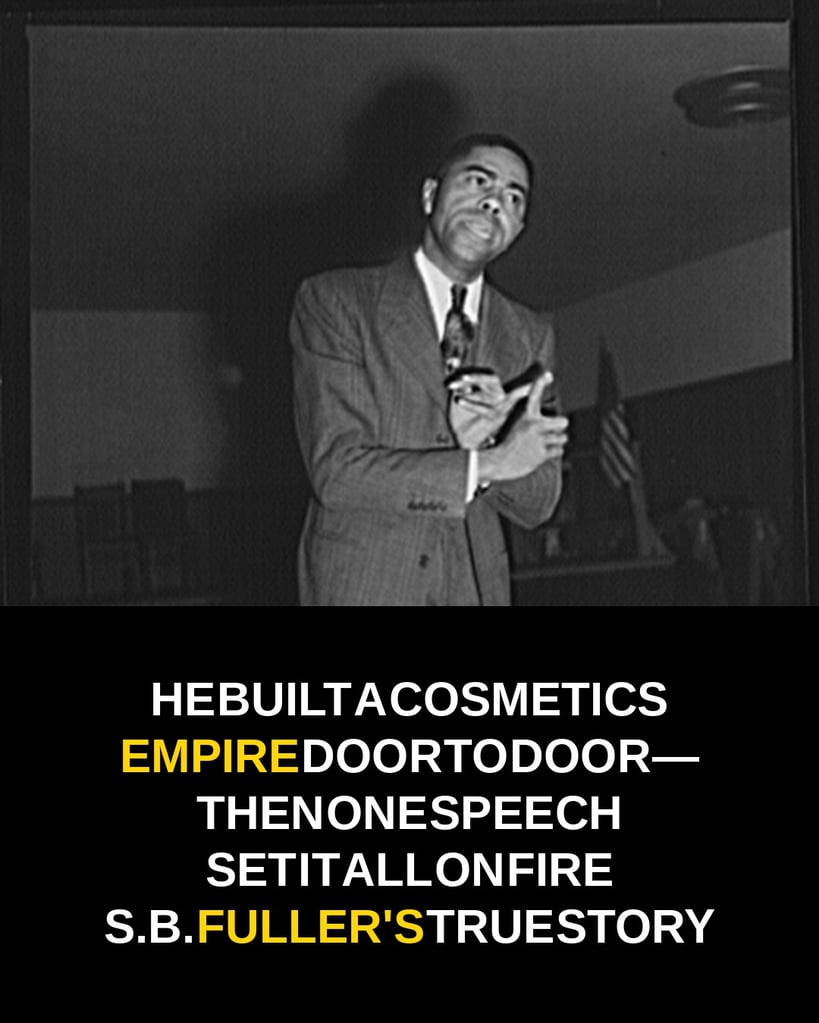
He started with $25 borrowed against his car. Samuel B. Fuller bought soap and cosmetics with it in the 1930s, sold them door to door in Chicago, and built Fuller Products into a company with roughly $18 million in sales and 5,000 salespeople in the 1950s. His story does not stop at the rise — and this page is not going to pretend it does. The fall is part of the record, too.
Samuel B. Fuller was born on June 4, 1905, in Monroe, Louisiana, to sharecroppers, and he was out of school after the sixth grade. That is the whole formal education behind one of the biggest Black-owned businesses of his era. What he had instead was a product, a route, and a partner: he sold door to door in Chicago with his wife Lestine.
Read the starting point again. Not an inheritance. Not a bank loan on easy terms. Twenty-five dollars, borrowed against his car, turned into inventory — soap and cosmetics he had to sell himself, face to face, house by house.
An empire that did not stay small
By the 1950s, Fuller Products had grown to roughly $18 million in sales and 5,000 salespeople. About a third of those salespeople were white — in an era when Black firms were expected to hire and sell only to Black customers. Fuller did not accept that limit. His company sold across the line that other people had drawn for it.
And in 1947, he made the move that showed how he thought about ownership: he bought out his own supplier, Boyer International. The man who had started by buying soap to resell now owned the company that had supplied him. That is the difference between selling a product and controlling the business behind it.
The founder who trained founders
Fuller Products was also, in effect, a business school for a generation. George E. Johnson worked for Fuller as a production chemist before building his own company, and Fuller mentored John H. Johnson and Joe Dudley as well. The pattern matters: one door-to-door operation did not just employ people for a season. It trained and encouraged founders who went on to build companies of their own. An empire that teaches is an empire that multiplies.
That is why Fuller’s name belongs in any honest history of Black business in America — not only for what he sold, but for who learned inside his company and carried that learning out into businesses of their own.
The whole arc — including the fall
Here is the part too many short tributes leave out. In 1963, a speech by Fuller criticizing Black leadership cost him dearly. In 1968, he entered a guilty plea over unregistered promissory notes, which led to probation and a $1.6 million repayment order. In the early 1970s, the company went through bankruptcy.
None of that erases the $25 start, the $18 million in sales, the 5,000 salespeople, or the founders he mentored. And none of the success erases the backlash, the plea, the repayment order, or the bankruptcy. Both halves are the story. Telling only the rise would turn a real life into a poster. Telling only the fall would erase what he actually built, and who he taught, along the way.
Samuel B. Fuller died on October 24, 1988, in Blue Island, Illinois. He had been born to sharecroppers in Louisiana, left school after the sixth grade, and still built a company that reached millions in sales — and a legacy that kept building through other people’s companies after his own hardest years.
Join the conversation
Be honest: had you heard S.B. Fuller’s name before today — the $25, the $18 million, AND the fall? And which part stays with you more, the rise or the founders he trained? Tell us below.
Source note: S.B. Fuller’s story — Samuel B. Fuller (June 4, 1905, Monroe, Louisiana – October 24, 1988, Blue Island, Illinois), born to sharecroppers and out of school after the sixth grade; borrowing $25 against his car in the 1930s to buy soap and cosmetics, sold door to door in Chicago with his wife Lestine; Fuller Products growing to roughly $18 million in sales and 5,000 salespeople in the 1950s, about a third of them white; buying out his supplier Boyer International in 1947; George E. Johnson working for Fuller as a production chemist, and Fuller mentoring John H. Johnson and Joe Dudley; the 1963 speech criticizing Black leadership that cost him dearly; the 1968 guilty plea over unregistered promissory notes, leading to probation and a $1.6 million repayment order; and the company’s bankruptcy in the early 1970s — with no precise founding year printed because sources conflict — is from Encyclopedia.com’s Fuller biography, History News Network, and business-history profiles.