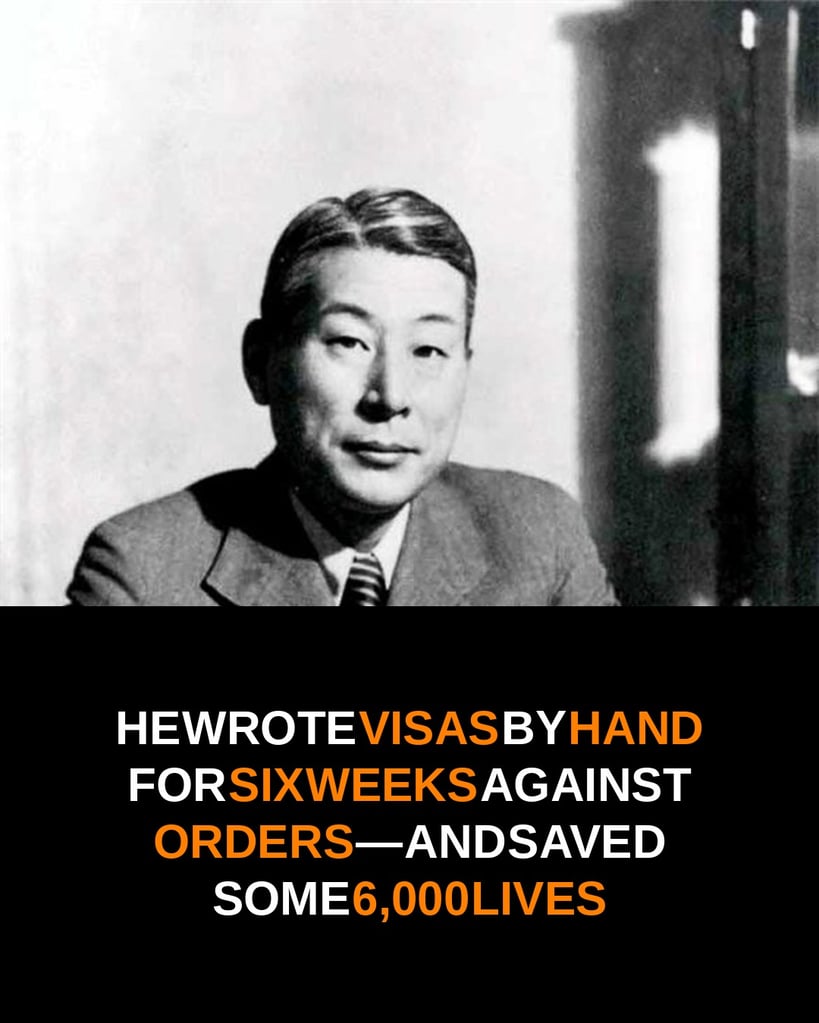
Three times he asked permission. Three times Tokyo said no. Then Chiune Sugihara, Japan’s vice-consul in Kaunas, Lithuania, sat down at his desk, picked up a pen, and started writing visas by hand — for six weeks, until his hands ached, against the direct orders of his own government, for Jewish refugees whose only other road led to the Nazis.
The summer of 1940 had brought thousands of refugees to Kaunas, fleeing ahead of the German advance, all of them hunting for one thing: a stamp that would let them travel east, across the Soviet Union on the Trans-Siberian Railway, to Japan and on to safety. The visa window was closing with the consulate itself. Sugihara cabled Tokyo three times for permission to issue transit visas in bulk. Three times, the answer was refusal.
So he issued them anyway. From July to early September 1940 he wrote visas by hand, day after day, working until his hands ached — and when the consulate closed around him, he kept writing, down to the last hours before his train left Kaunas.
The honest numbers of a rescue
This page prints the count the documented way, because his record deserves precision instead of inflation. Sugihara’s own 1941 diplomatic report documents 2,139 transit visas — 1,500 of them itemized to Jews and Poles. But most visas went to heads of households traveling with their families, so the number of people who actually escaped is estimated at about 6,000. More than 2,000 visas documented. An estimated 6,000 lives. The gap between those numbers isn’t a mystery — it’s wives, children and parents carried on a father’s stamp.
He remains the only Japanese national ever named Righteous Among the Nations by Yad Vashem — recognized in 1984, with the honor accepted by his family in 1985 as his health failed. He died in 1986, having spent his postwar years in modest obscurity while the people his pen carried scattered across the earth and multiplied into generations.

Consider what his weapon was. Not an army, not a fortune — a consular stamp, a pen, and a conscience that outranked three refusals. Bureaucracy is usually how cruelty files its paperwork. In Kaunas, for six weeks, one bureaucrat ran the paperwork in the other direction, by hand, until his fingers gave out.
The route his visas opened deserves to be pictured whole, because it shows how narrow the door was that he held. A Sugihara transit visa let a refugee family board the Trans-Siberian Railway, cross the entire Soviet Union, reach a Pacific port, sail to Japan — and from Japan, continue on to safety elsewhere in the world. Every stage of that journey depended on the stamp at its start. Without Kaunas, there was no train, no ship, no arrival. That is why the count is told in families: some 6,000 people are estimated to have escaped on 2,139 documented visas, because a visa in a father’s pocket carried his wife and children through every checkpoint between Lithuania and the Pacific.
Join the conversation
He disobeyed his own government three times over to save strangers. Have you ever heard Chiune Sugihara’s name — and be honest, if your orders and your conscience gave opposite answers, which one wins? Tell us below.
Source note: Chiune Sugihara’s account — Japan’s vice-consul in Kaunas, Lithuania, asking Tokyo three times for permission to issue transit visas to Jewish refugees and being refused; writing visas by hand from July to early September 1940, working until his hands ached and continuing as the consulate closed; his own 1941 diplomatic report documenting 2,139 transit visas (1,500 itemized to Jews and Poles), with the number of people who escaped estimated at about 6,000 because most visas covered heads of households traveling with families; the escape route via the Trans-Siberian Railway to Japan and on to safety; his naming as Righteous Among the Nations by Yad Vashem (recognized 1984, the honor accepted by his family in 1985), remaining the only Japanese national so honored; and his death in 1986 — is from Yad Vashem, the European Jewish Congress, and the St. Louis Jewish Light.
Tell us in the comments below - we read every single one, and the best takes get featured.