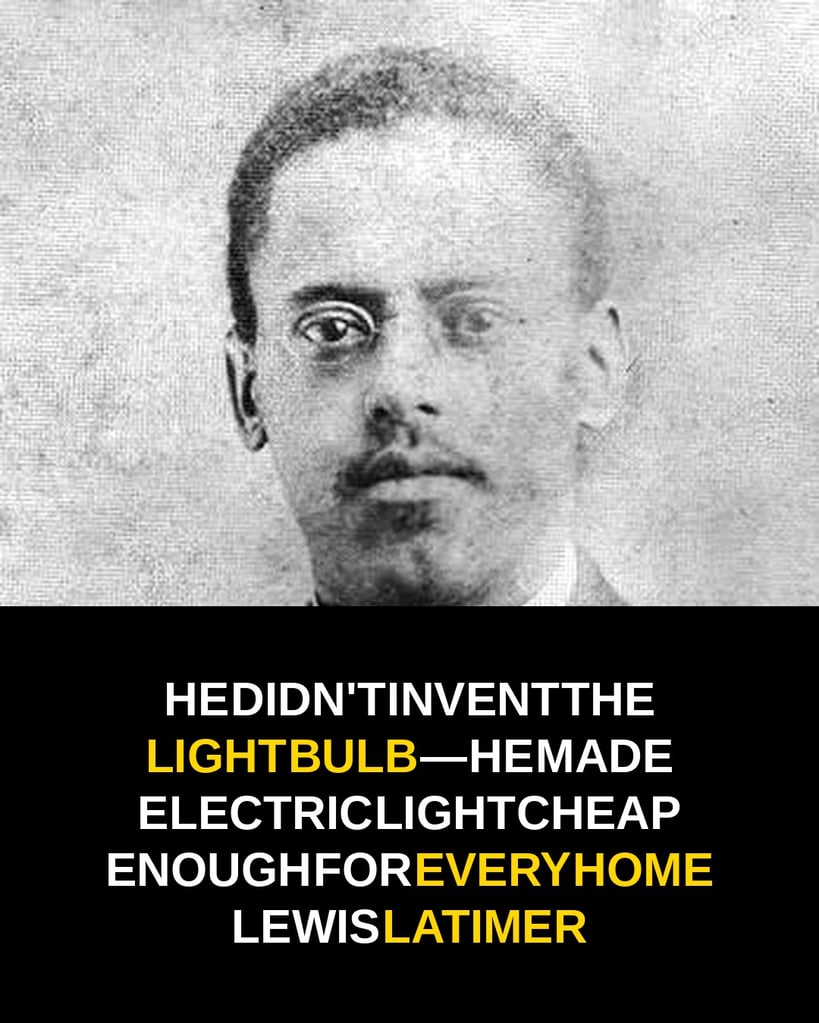
Let us start by killing the viral claim, because the truth is better: Lewis Latimer did NOT invent the light bulb. What he did was arguably more useful — he made the bulb’s heart manufacturable, so electric light could become cheap and reliable enough for every home in America.
Lewis Latimer was born on September 4, 1848, in Chelsea, Massachusetts. He was a self-taught draftsman and inventor — a man who taught himself the technical drawing and the science that other men got from schools that would not have admitted him. His genius did not announce itself with one famous object. It showed up in the hard, practical problem standing between a laboratory curiosity and a light in your kitchen.
That problem was the filament. Early light bulbs failed because their carbon filaments burned out or broke. A bulb whose heart dies young is not a product; it is a novelty for the rich. Electric light would stay a toy until somebody made filaments that could be manufactured reliably and last.
The process that made the filament work
Latimer, together with Joseph V. Nichols, co-patented the “Process of Manufacturing Carbons” — U.S. Patent 252,386, granted on January 17, 1882. The patent was assigned to Hiram Maxim’s U.S. Electric Lighting Company, one of the major lighting firms of the day. Latimer’s process made filaments that could be manufactured reliably and last — a key step in making electric lighting practical and affordable.
Read that carefully, because this is where the real history lives. Invention is not only the flash of an idea. It is the process that lets a factory make the idea ten thousand times, the same way, at a price a family can pay. Latimer’s genius was making the bulb’s heart manufacturable. Edison’s bulb predates him — but a bulb the world cannot afford to make is a bulb the world cannot use. Latimer helped close that gap.
Inside Edison’s own circle
His standing among the men of that industry was not charity; it was earned and it was recorded. Latimer went on to work for Edison’s company. And in 1918, he was the only African American among the founding members of the Edison Pioneers — the organization of Edison’s original associates. The only one. The men who built electric light with Edison themselves counted Latimer as one of their own founding number.
So retire the false version with confidence, and replace it with the true one. Not “he invented the light bulb” — he didn’t, and he doesn’t need the lie. He made carbon filaments reliable. He made them last. He made them manufacturable. That is how electric light got cheap enough to leave the laboratory and enter every home in America.
Lewis Latimer died on December 11, 1928, in Flushing, New York, at 80. Every time a room lights up at the flip of a switch, cheaply and without a thought, some part of that ordinary miracle runs through a process patented in 1882 by a self-taught Black draftsman from Chelsea.
Join the conversation
Be honest: had you heard the false “he invented the light bulb” version — and do you agree the real story, the filament that made light affordable, is actually greater? Tell us below.
Source note: Lewis Latimer’s story — born September 4, 1848, in Chelsea, Massachusetts, and died December 11, 1928, in Flushing, New York, at 80; a self-taught draftsman and inventor; his co-patent with Joseph V. Nichols of the “Process of Manufacturing Carbons” (U.S. Patent 252,386, January 17, 1882), assigned to Hiram Maxim’s U.S. Electric Lighting Company; early light bulbs failing because their carbon filaments burned out or broke, and his process making filaments that could be manufactured reliably and last, a key step in making electric lighting practical and affordable; his later work for Edison’s company; his place in 1918 as the only African American among the founding members of the Edison Pioneers, the organization of Edison’s original associates; and the correction that “Latimer invented the light bulb” is false, Edison’s bulb predating him — is from the IEEE Engineering and Technology History Wiki, the Lewis Latimer House Museum, and patent records.