
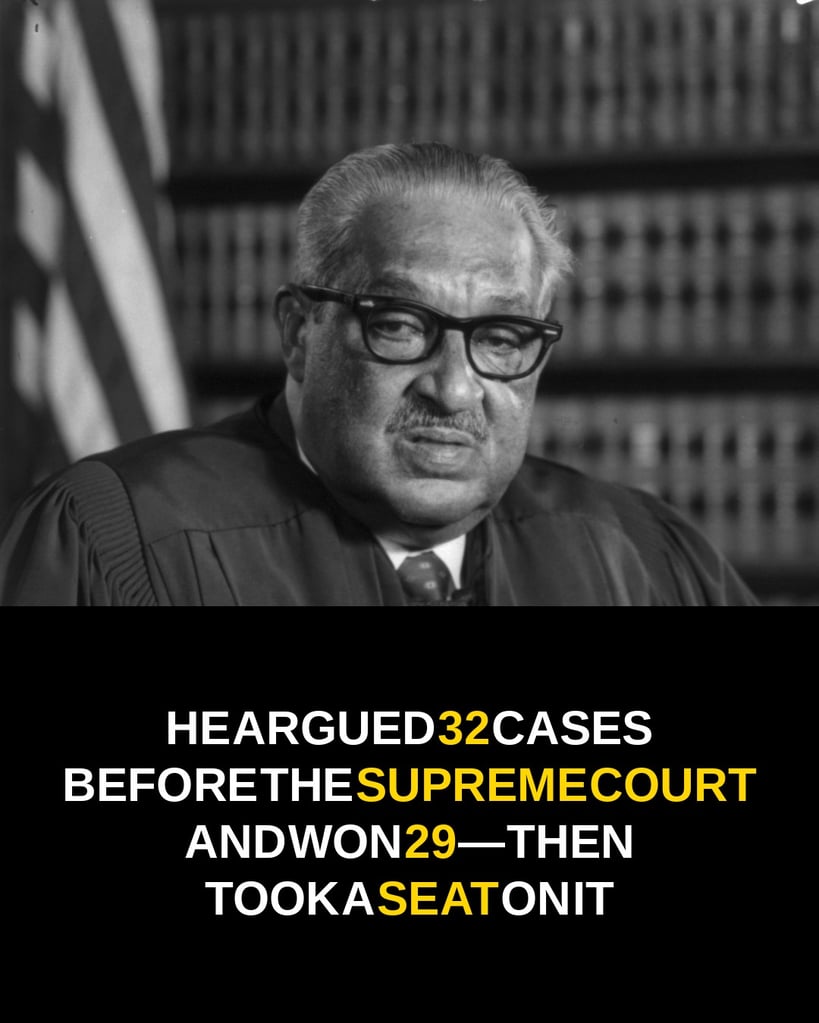
His won-loss record in the hardest courtroom on Earth: 32 argued, 29 won. Thurgood Marshall spent decades walking into hostile courtrooms across America as the NAACP’s chief counsel, arguing for the rights of people the law had written off — and then, on October 2, 1967, the man who had argued before the Supreme Court took a seat on it, its first African American justice.
The road began with a rejection that tells you the whole era: the University of Maryland’s law school denied Marshall admission because of his race. He went to Howard University instead and graduated top of his class — then spent his career crisscrossing the country, arguing civil-rights cases in towns where a Black lawyer’s life was part of the stakes. The travel alone was a risk profile. The record he built was the rebuttal: 32 cases argued before the U.S. Supreme Court, 29 won.
Among the 29: Smith v. Allwright in 1944, which struck down whites-only primary elections — the ruling that opened the ballot box’s first lock across the South. And towering over all of them, on May 17, 1954, Brown v. Board of Education: Marshall arguing, and winning, the unanimous ruling that declared school segregation unconstitutional — the legal earthquake that cracked the foundation of Jim Crow itself.
From the lectern to the bench
President Johnson made him the first Black Solicitor General in 1965 — the government’s own top advocate before the Court. Then, in 1967, Johnson nominated him to the Court itself. He was sworn in on October 2, 1967, the first African American Supreme Court justice, and he served 24 years, until 1991 — deciding, from the bench, the kinds of cases he had once had to beg that same bench to hear.
Consider the symmetry the country rarely earns. A man refused by a law school for his race becomes the nation’s most successful Supreme Court advocate, then its first Black justice. Maryland’s rejection letter and the Court’s commission belong in the same frame: one shows what the gatekeepers intended; the other shows what the man did with the long way around.
Every lawyer who has ever argued a civil-rights case since walks a road Marshall surveyed — town by town, courtroom by courtroom, 29 victories deep.
The cases between the famous ones fill in the man. Smith v. Allwright in 1944 struck down the whites-only primary — the device by which the one-party South had kept Black voters from the only elections that mattered — eight years before Brown was even argued. Marshall’s Supreme Court practice was like that: case after case chosen as bricks, each one removing a specific stone from the legal architecture of segregation, each one argued by a lawyer who had often traveled through the very jurisdictions whose laws he was dismantling. By the time he stood up for Brown v. Board on the road to May 17, 1954, the unanimous ruling landed on ground he had been preparing for a decade. Twenty-nine wins out of thirty-two wasn’t a hot streak. It was a demolition schedule.
Join the conversation
Thirty-two argued. Twenty-nine won. A unanimous Brown v. Board among them. Were you taught Thurgood Marshall’s record in school — the actual numbers? And is there a “long way around” story in your own family that ended at the top table? Tell us below.
Source note: Thurgood Marshall’s account — denied admission to the University of Maryland’s law school because of his race, graduating instead from Howard University at the top of his class; his career as the NAACP’s chief counsel arguing civil-rights cases across the country; his record of 32 cases argued before the U.S. Supreme Court with 29 won, including Smith v. Allwright (1944, striking down whites-only primaries) and Brown v. Board of Education, the unanimous May 17, 1954 ruling that school segregation was unconstitutional; his appointment by President Johnson as the first Black Solicitor General in 1965; and his swearing-in on October 2, 1967 as the first African American Supreme Court justice, serving 24 years until 1991 — is from his sourced biography, National Geographic, and EBSCO Research Starters, with the 29-of-32 record consistent across all of them.