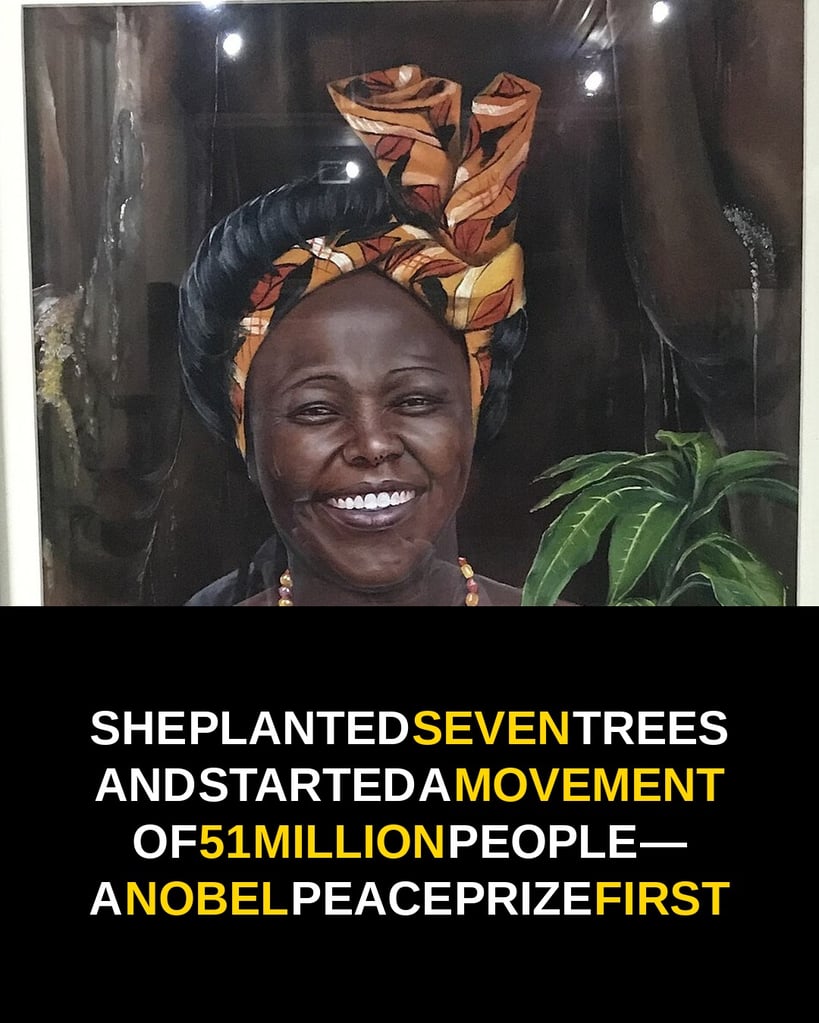
It started with seven trees. Not a forest, not a foundation with a headquarters and a logo — seven trees, planted on World Environment Day in 1977 by a Kenyan woman named Wangari Maathai. From those seven, the Green Belt Movement she founded has planted more than 51 million trees across Kenya. Some revolutions start with a march. Hers started with a shovel.
Maathai saw two crises braided into one. Kenya’s land was being stripped — trees cut, soil washing away, firewood vanishing. And Kenya’s rural women, who walked farther every year for wood and water, were carrying the cost of all of it on their backs. Her answer connected the two: pay women to plant seedlings. Conservation that fed families. Trees that were also income, and income that was also independence.
The movement trained some 30,000 women in the work. Read that number alongside the trees, because they are the same number wearing two faces: every million trees in the ground represents women who learned a skill, earned money, and stood a little more upright in their own villages. Maathai didn’t plant a forest. She planted an economy with roots.
The firsts she carried
She was the first woman in East and Central Africa to earn a PhD, in 1971, from the University of Nairobi — a door she walked through a generation before most of her countrywomen could see it. And in 2004, the world gave her its highest honor for peace: the Nobel Peace Prize, making her the first African woman ever to receive it. The citation named her ground exactly: “for her contribution to sustainable development, democracy and peace.”
Peace, from planting trees. The committee understood what the women of the Green Belt Movement had known since 1977 — that a woman with income, standing on land that isn’t washing away, is a foundation nothing shakes easily. Maathai spent decades being arrested, beaten and mocked by men in power who understood exactly how dangerous an organized woman with a shovel could be. She planted anyway. Fifty-one million times, the movement planted anyway.
She died on September 25, 2011, at 71. The trees didn’t. Somewhere in Kenya today there is shade, soil and firewood standing where seven saplings went into the ground on an environment day in 1977 — multiplied by millions, because one woman treated a seedling like a strategy.
The Nobel committee’s citation is worth slowing down over, because it connected dots her critics preferred to keep separate: “sustainable development, democracy and peace.” Maathai had argued for years that these were one subject — that a woman with income from seedlings is harder to silence, that land which isn’t eroding doesn’t drive families into conflict, that planting a tree in public, as a citizen, is a political act. The first woman in East and Central Africa to earn a PhD, back in 1971, spent the rest of her life proving her thesis at a scale of 51 million trees. The committee didn’t give a peace prize to a gardener. It recognized a strategist whose weapon happened to grow.
Join the conversation
Seven trees to 51 million, and 30,000 women trained along the way. Did you know the first African woman to win the Nobel Peace Prize won it for planting trees? And what “seven trees” could your family start this year? Tell us below.
Source note: Wangari Maathai’s account — founding the Green Belt Movement in 1977, beginning with planting seven trees on World Environment Day that year; the movement having since planted more than 51 million trees across Kenya and trained some 30,000 women, paying women to plant seedlings; Maathai being the first woman in East and Central Africa to earn a PhD (1971, University of Nairobi); her winning the Nobel Peace Prize in 2004 as the first African woman to receive it, cited “for her contribution to sustainable development, democracy and peace”; and her death on September 25, 2011, at 71 — is from NobelPrize.org (the official citation) and the Green Belt Movement.