
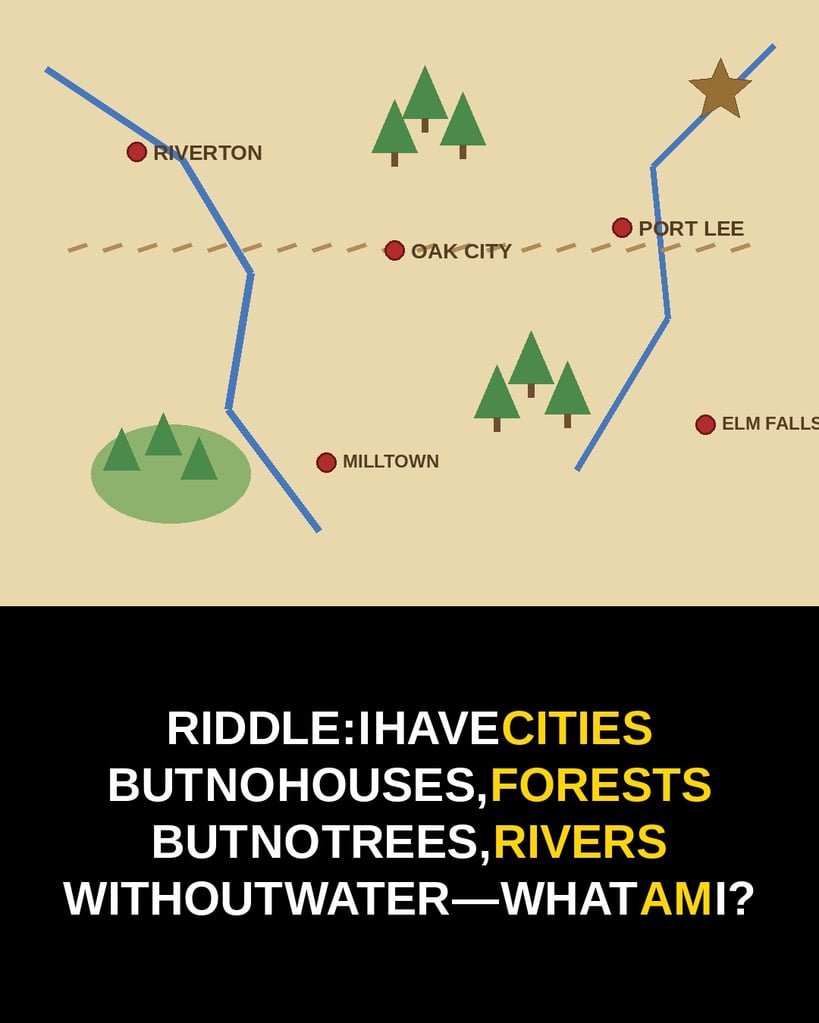
The answer is a map.
Here’s the riddle: “I have cities but no houses, forests but no trees, and rivers without water. What am I?”
Work it through clue by clue. “Cities but no houses”: a map shows you every city by name and location — but there isn’t a single real house anywhere on it, because nothing drawn on a map is the thing itself. “Forests but no trees”: a map marks forests as green shapes and labels, yet you will never find one actual tree growing out of the paper. “Rivers without water”: a map draws every river as a blue line from source to sea — and that line is perfectly dry. You could run your finger along the whole river and never get wet.
That’s the riddle’s whole trick: every clue describes something a map represents without containing. A map draws cities, forests and rivers as symbols and lines — the places are all there, but nothing on the paper is real. Once you flip your thinking from “things” to “pictures of things,” all three clues click into place at the same time — and that’s the sign of the right answer. No other guess satisfies all three: a globe is just a map wrapped around a ball (a fair near-miss, but the classic answer is the map itself), and a photograph of one place can’t hold every city, forest and river at once.
Did the map give itself away, or were you hunting for a magical country where rivers run dry? Drop your first guess in the comments — and try tomorrow’s riddle on our page.

